The massive shadow fell over the subterranean complex, the air itself seeming to compress under the weight of impending destruction. A colossal payload, designed for sheer destructive force, descended towards a hidden network of tunnels. From the sky, the delivery mechanism, a familiar cargo aircraft, prepared to release its devastating cargo over the Afghan landscape. This was the moment a modern military arsenal showcased a weapon of staggering proportions, capable of reshaping the terrain beneath it.
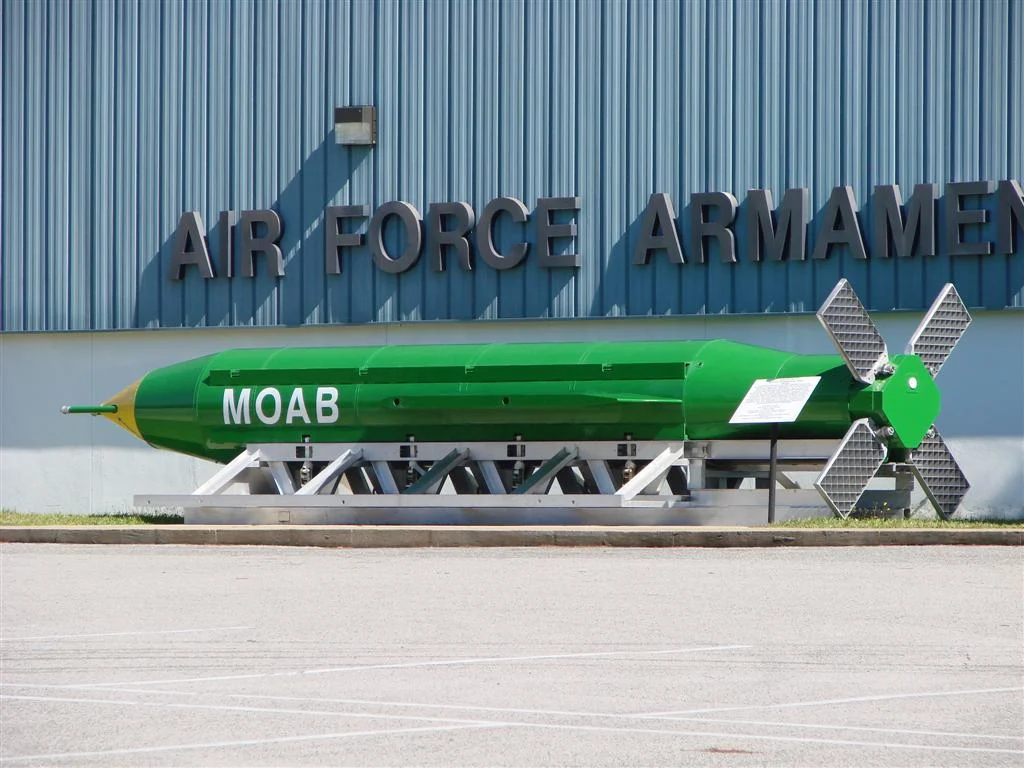
This weapon, known by the imposing moniker GBU-43/B MOAB, represented a significant leap in conventional military ordnance. Its sheer destructive capability meant that, at the time of its development, it stood as the most potent non-nuclear weapon available to the United States military. Its creation was not an incremental upgrade but a substantial rethinking of what a conventional bomb could achieve, designed to deliver overwhelming force against hardened or concealed targets.
The genesis of a massive punch
The journey to such a powerful piece of hardware began within the confines of the Air Force Research Laboratory, where Albert L. Weimorts, Jr. was stationed. It was conceived in a climate of urgent, if uncertain, tactical requirements, making it what was described as a ‘crash project’ for immediate operational needs. The notion of such a bomb gained traction when the Pentagon suggested its use as part of a ‘shock and awe’ strategy during the 2003 invasion of Iraq.
The physical delivery system was equally specialized, requiring the use of C-130 Hercules aircraft, specifically the MC-130E or MC-130H variants. Rather than being carried on a traditional munition drop, the weapon was designed to be deployed via an airdrop platform, utilizing drogue parachutes for its descent, with no retarding parachute being employed. The underlying technical concept for the bomb was modelled after the existing BLU-82 Daisy Cutter bomb, adapting its principles for a dramatically increased yield.
Testing the colossal payload
The development process involved rigorous testing to validate the weapon’s destructive potential. The first formal test of the device took place on 11 March 2003, using explosive tritonal. Further validation followed shortly after, with a second major test scheduled for 21 November 2003. During this period, the scale of the undertaking became apparent, with 15 units of the MOAB being manufactured at the McAlester Army Ammunition Plant, beginning in 2003.
The construction details were equally immense, featuring a relatively light aluminum casing weighing only 2,900 pounds, yet it was engineered to house a massive 18,700 pounds of Composition H-6 material. This composition allowed the weapon to boast a yield that was comparable in magnitude to smaller tactical nuclear weapons, such as the M-388. While a larger bomb, the Grand Slam, weighed 22,000 lb, the MOAB achieved its overwhelming power while remaining considerably lighter.
Targeting the hidden threat
The deployment profile for the MOAB suggested specific tactical applications. It was primarily conceived as an air burst bomb, making it highly effective against targets situated on the surface, ranging from soft to medium hardness. Critically, it was not designed as a penetrator weapon, meaning its utility was less focused on tunneling through rock and more geared towards clearing out vast, open areas like deep canyons or caves.
The weapon saw its first combat use on 13 April 2017, when it was deployed in Afghanistan. This specific strike targeted an Islamic State – Khorasan Province tunnel complex, an instance where the bomb was dropped on ISKP in Nangarhar Province. Following this 2017 strike, an Afghan spokesman noted that “94 ISKP militants killed in 2017 strike.”
The enduring implications of overwhelming force
The existence and deployment of the MOAB highlighted a military doctrine favouring overwhelming kinetic force. While the initial suggestions for the weapon were linked to the 2003 Iraq invasion, its subsequent use demonstrated its continued relevance in counter-insurgency operations against deeply embedded militant groups. The unit price, which the Air Force stated was $170,000 at a historical cost, speaks to the sheer industrial commitment behind such specialised hardware.
The weapon’s operational profile—guided to its target using GPS satellite-guidance—showed a marked evolution in battlefield technology being integrated into massive explosives. The name itself, “Mother of All Bombs,” was, as the source noted, “colloquially given,” reflecting the public perception of its devastating capacity.
The MOAB remains a potent illustration of the perpetual arms race between military engineering and defensive architecture. It serves as a stark reminder of the immense physical force that can be projected onto a specific, localized point on the globe. When the shadow falls again, the memory of that massive payload descending from the sky remains impossible to ignore.
Background: Wikipedia