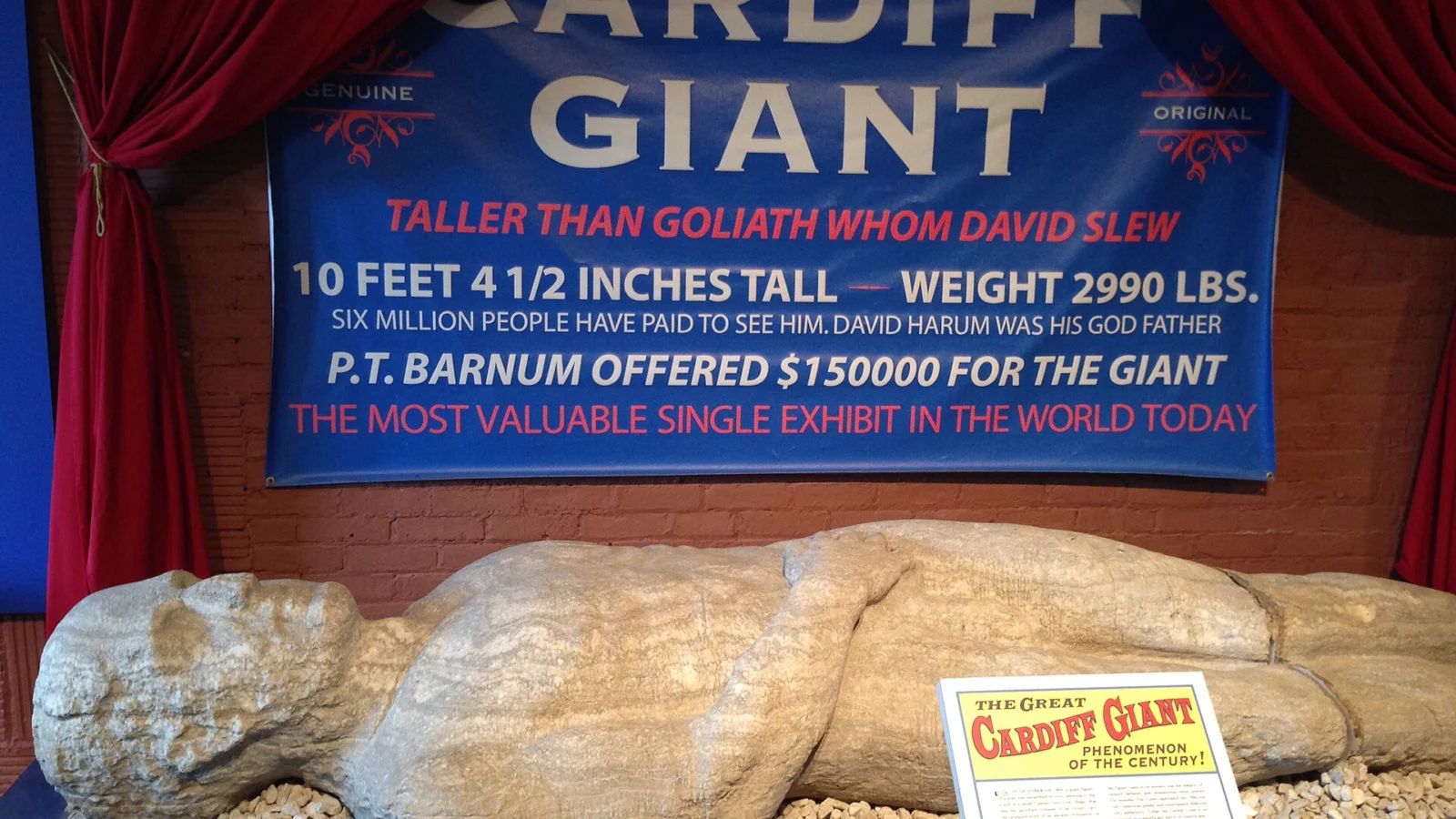
The dust motes danced in the dim light filtering into the well behind William C. “Stub” Newell’s barn. It was a quiet, unremarkable patch of earth in Cardiff, New York, until October 16, 1869. Workers digging the foundations stumbled upon something impossible: a colossal, stone-like figure emerging from the soil. The sheer scale of the find was breathtaking, suggesting a relic of impossible antiquity. The object, a purported petrified man, loomed silently, defying the mundane setting of the rural farmyard.
This discovery quickly captivated the public imagination, transforming a simple digging job into a sensational archaeological event. The giant was claimed to be a fossilized human specimen, measuring an astonishing ten feet tall and weighing roughly three thousand pounds. The notion of such a massive, ancient skeleton unearthed in American soil was revolutionary, promising to reshape understanding of human history and geological time. The sensational nature of the ‘Cardiff Giant’ ensured that the story of this supposed ancient titan would spread far beyond the small town of Cardiff.
Read more: Pan Am Flight 841 hijacking: The story of a student’s revenge
The motive behind the monolith
The colossal find was, in fact, the product of a meticulous and elaborate fabrication engineered by George Hull. A tobacconist based in New York, Hull was driven by intellectual and philosophical debate, specifically an argument surrounding Genesis 6:4 and the emerging theories of evolution. He harboured a desire to demonstrate how readily the general public could be deceived by a sophisticated piece of artifice.
The creation of the giant was a significant undertaking, beginning even before it appeared in Cardiff. The gypsum block, which formed the basis of the statue, was sourced from Fort Dodge, Iowa, in 1868. Hull contracted sculptors, Henry Salle and Fred Mohrmann, to bring his vision to life. The raw material was not merely shaped; it was painstakingly treated. Hull had the giant’s hair and beard removed, as these elements were not expected to petrify naturally, and the stone was then treated with acids and sand to give it the appearance of deep age and weathering.
Scientific scrutiny and public frenzy
The sheer magnitude of the fraud was only matched by the intense scientific interest it garnered upon its supposed discovery. The giant was transported via railroad to William Newell’s farm in November 1868, establishing the grand stage for its eventual unveiling. Initial scientific skepticism began immediately. The first geologist to inspect the massive figure, John F. Boynton, quickly determined that the object was not a fossilized human.
The doubts deepened as more prestigious academics were called to examine the relic. Andrew D. White, the president of Cornell University, conducted a close inspection of the giant, lending institutional gravity to the debate. Yet, it was the pronouncements of Yale paleontologist Othniel C. Marsh that delivered the most damning verdict, famously calling the statue “a most decided humbug.” Despite the growing weight of expert opinion, the popular frenzy continued unabated, fuelled by the promise of revolutionary discoveries.
The inevitable unraveling
The hoax reached its commercial zenith when P. T. Barnum created a plaster copy, asserting that his rendition was the authentic specimen. During this period of peak public interest and commercial exploitation, the pervasive scepticism of the era was captured by the cynical observation of David Hannum, who remarked, “There’s a sucker born every minute.”
However, the elaborate deception could not be maintained forever. George Hull eventually confessed to the entire press on December 10, 1869, admitting to the entire fabrication. The subsequent revelation that both the original and Barnum’s plaster copies were fraudulent arrived officially on February 2, 1870. Hull himself offered a chilling explanation for his scheme, stating, “I intended for the hoax to be exposed to reveal the tendency of the Christian community to believe in things too easily.”
A persistent piece of Americana
The Cardiff Giant remains a fascinating case study in the intersection of science, showmanship, and human gullibility. Although the giant was revealed to be a meticulously crafted piece of gypsum, its story captured the public imagination during a critical period of scientific change. It serves as a bizarre footnote to the history of American archaeology, illustrating how easily popular belief can override established scientific methods.
Today, the original statue endures, displayed at Fenimore Farm & Country Village in Cooperstown, New York. It stands not merely as a fake fossil, but as a monument to the power of a well-told, colossal lie. The giant, once unearthed, still looms, a silent testament to the moments when reality bends to the will of a single creator.
More from Ungrid Now
- Monument to the Unknown Soldier in Baghdad: A massive tribute to war
- Yvonne fletcher shooting: Police officer killed in 1984 protest
Background: Wikipedia