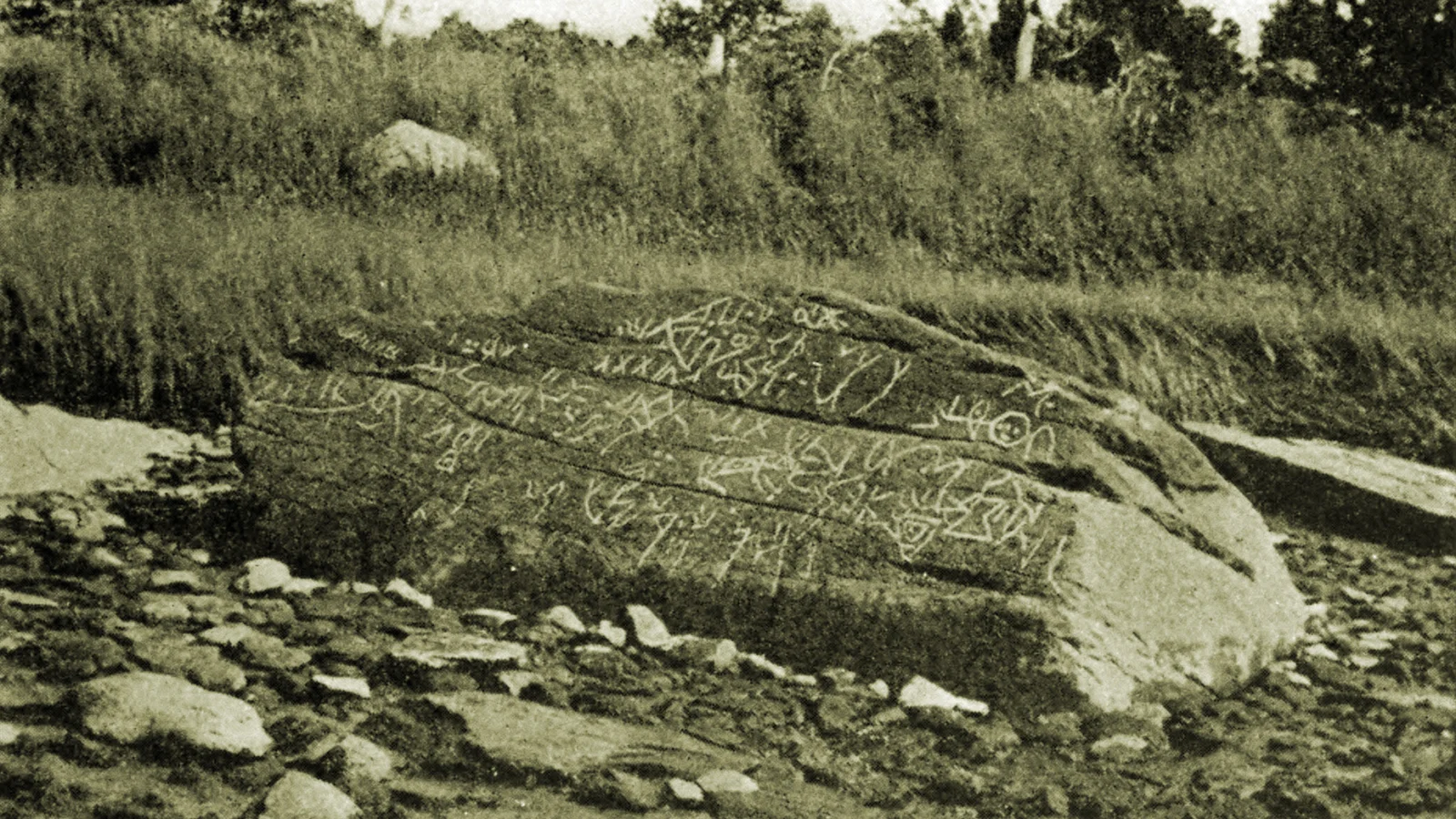
The massive, gray-brown crystalline block stood silently, a monumental piece of ancient history anchored in the Massachusetts landscape. Its surface bore a complex tapestry of lines, geometric shapes, and schematic drawings, etched deeply into the sandstone. This imposing structure, a forty-ton boulder, held secrets that had baffled scholars and enthusiasts for centuries.
This remarkable stone was far more than a mere geological feature; it was an enigmatic canvas of human activity, a focal point for debates spanning pre-Columbian American cultures to far-flung global empires. The inscribed face, a trapezoidal incline oriented at seventy degrees to the northwest, provided a mysterious script, containing designs that were simultaneously ancient and inherently uncertain in their origin.
Read more: Kryptos sculpture: The CIA’s unsolved code that baffles the world
The rock’s journey from riverbed to museum
Originally, the immense boulder resided within the Taunton Riverbed at Berkley, Massachusetts. It had been a prominent feature of the land that once constituted the town of Dighton, a powerful marker in the regional history. The first attempts to document its strange markings appeared quite early, with Rev. John Danforth creating a drawing of the petroglyphs back in 1680. Later, Rev. Cotton Mather brought the rock into wider intellectual focus, describing it in his 1690 publication, The Wonderful Works of God Commemorated. As Mather observed, “Among the other Curiosities of New-England, one is that of a mighty Rock…”
The rock’s significance was frequently recognised, prompting suggestions that its unique markings could be repurposed for modern civic life. For instance, James Russell Lowell proposed that the script found on the boulder could be used for presidential candidates’ letters, a thought that underscored the fascination the design held for 19th-century thinkers. Despite this early interest, subsequent observers noted issues with the clarity of the carvings; Sewall noted in 1768 and Kendall in 1807 that the lines were heavily effaced, suggesting the markings had suffered significant wear over time.
The enduring mystery of the carvings
The nature of the carvings remains highly ambiguous, containing both verified and unverified forms of writing. The sheer age and complexity of the designs fueled a torrent of speculative theories over the centuries. One theory proposed that the etchings were the work of American Indians, while others pointed toward much older civilizations, such as the Ancient Phoenicians.
The hypotheses grew increasingly global, moving far beyond the American continent. In 1837, Carl Christian Rafn put forward the Norse theory, suggesting a Scandinavian connection to the rock’s creation. This was followed by Edmund B. Delabarre proposing Portuguese explorers in 1912, and later, Gavin Menzies suggested Chinese explorers in his 2002 work. These theories illustrate how, across generations, the boulder became a proxy for questioning global historical narratives.
Preservation and modern scrutiny
The rock’s precarious position and importance eventually necessitated official intervention for its preservation. State officials decided to remove the forty-ton boulder in 1963, a process carried out during the construction of a coffer dam. Following its relocation, the boulder was installed within a museum located in Dighton Rock State Park. This effort led to the rock being formally listed on the National Register of Historic Places in 1971.
While early descriptions sometimes exaggerated the depth of the incisions, as early reports suggested, more accurate observations began to emerge over time. Greenwood provided the first reliable description of the rock in 1730, helping to ground the historical account. Furthermore, more recent investigations, such as the work by Hunter in 2017, provided evidence that actively worked to debunk the long-standing Corte-Real origin myth, contributing to a more nuanced understanding of its origins.
A silent testament to forgotten histories
Today, the boulder sits as a powerful, silent testament to the deep, often unknown history buried beneath the surface of the American continent. It forces a contemplation not just of the past, but of the limitations of human understanding when confronted with truly ancient artifacts. The rock serves as a potent symbol of the enduring quest for connection—a physical piece of history that connects disparate cultures, timelines, and theories. It remains a stunning example of how a single, slanted block of sandstone can hold the weight of countless unanswered questions, echoing the moment it was first spotted in the Taunton Riverbed.
More from Ungrid Now
- Tomb of the Unknown Soldier: Honouring Canada’s fallen heroes
- Santa Maria La Nova: Naples’ Stone Testament to Faith and Mystery
Background: Wikipedia