The silence of deep space was suddenly shattered by a fleeting, high-frequency whisper. On May 15, 2015, a single radio signal pierced the void, lasting only two brief seconds. It originated from the direction of a distant star system, a sudden, unexpected burst of energy that captivated researchers worldwide. This momentary transmission, observed at 11 GHz, was a powerful, yet ephemeral, beacon.
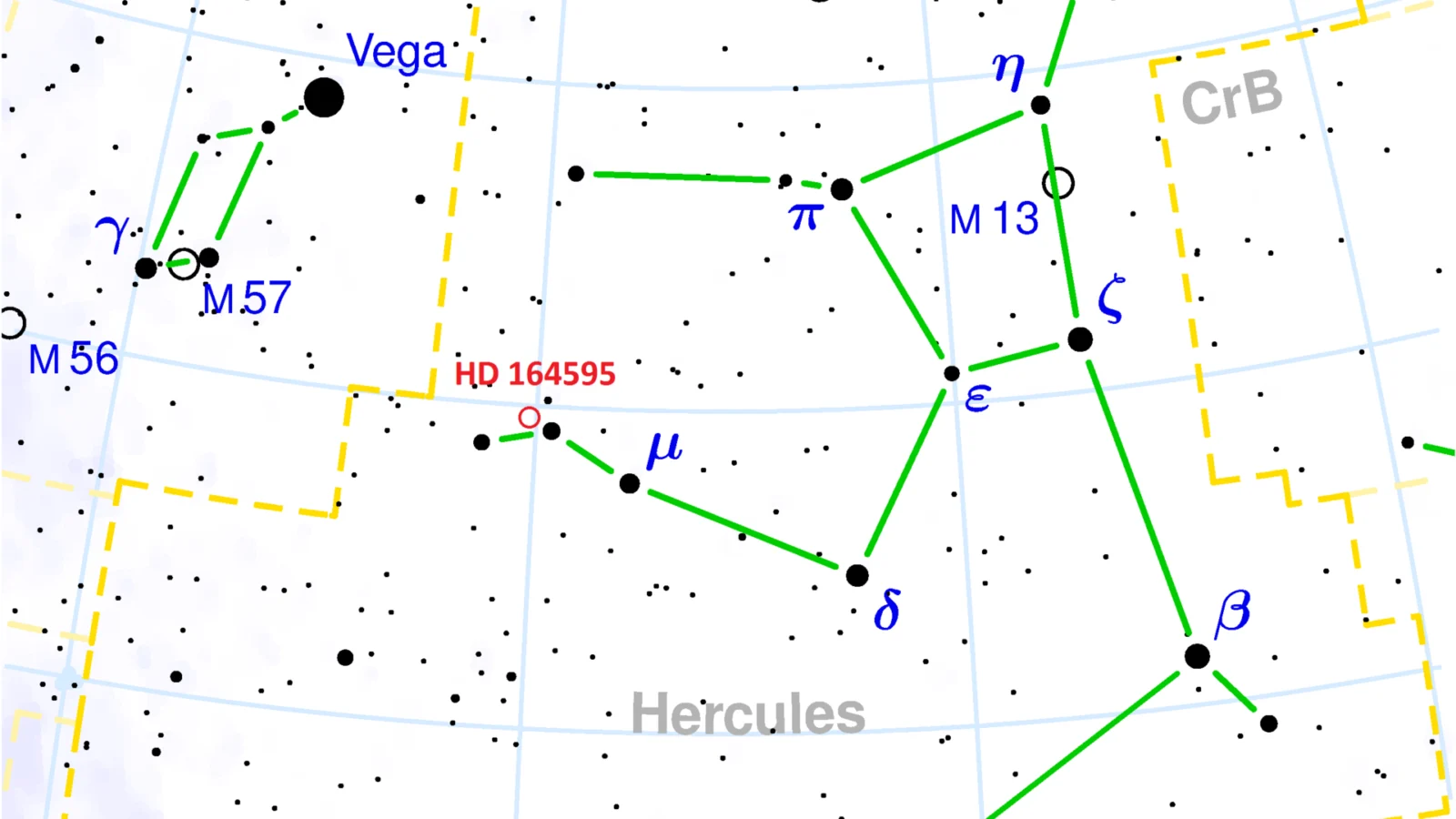
This distant object, designated HD 164595, is far more than just a faint point of light; it is a complex cosmic pairing, a wide binary system located 92 light years away in the northern constellation of Hercules. While the system itself is too dim for casual viewing, the brighter component can be spotted with a small telescope or binoculars near the star Xi Herculis. The remarkable nature of HD 164595 lies in its perfect blend of stellar types, hosting a near-perfect solar analogue alongside a tiny, ancient red dwarf, all while orbited by a sizeable exoplanet.
The stellar pairing and its peculiar dance
The HD 164595 system consists of two distinct stellar companions, separated by a vast expanse of space. The primary star, known as Component A, is a G-type main-sequence star, classified specifically as G2 V. Scientists have noted that Component A bears a strong resemblance to our Sun, with estimated mass, radius, and luminosity figures that are strikingly similar. It is considered an excellent candidate for being a solar twin, although studies have indicated that its metallicity is slightly lower than that of our own star.
Its partner, Component B, stands in stark contrast. This secondary star is a diminutive red dwarf, specifically of the M2.5 V spectral class. The two stars maintain a projected separation of approximately 2,509 AU from one another. Based on photometric analysis of light curve variations, the red dwarf has a distinct rotation period of 43.5 days. This pairing illustrates how stellar evolution allows for the existence of vastly different types of stars to orbit in close proximity within the same stellar family.
Distant wanderers and orbiting worlds
The celestial mechanics of HD 164595 are surprisingly dynamic, even across such immense distances. The entire binary system is not static; it is actively drifting away from Earth. Measurements of its radial velocity indicate that it is receding at a rate of 2.0 km/s. Furthermore, the system exhibits a measurable proper motion of 0.222″ yr−1 as it traverses the celestial sphere.
The system also harbors a fascinating planetary resident: HD 164595 b. This exoplanet orbits Component A, the primary star, completing a full circuit every 40 days. Its existence was confirmed through the precise radial velocity technique, utilising the SOPHIE spectrograph. Initial calculations placed the minimal mass equivalent of this planet at 16 Earths, making it a substantial world orbiting a star that mirrors our own Sun.
A cosmic whisper and the hunt for intelligence
The most intriguing element of the system is the brief, unexplained radio event that occurred in 2015. On May 15th, N. N. Bursov and Claudio Maccone, using the RATAN-600 facility, recorded a single signal at the frequency of 11 GHz. This transient burst only lasted for two seconds, leading to a Rio Scale score of 1 or 2, which places it in the category of highly ambiguous signals.
The immediate aftermath of this discovery saw intense debate among scientific communities. Seth Shostak of the SETI Institute stressed that definitive confirmation by a second telescope was absolutely necessary before any conclusions could be drawn. Meanwhile, Nicholas Suntzeff proposed that the signal might have originated from a military frequency band, suggesting a terrestrial, man-made origin. The observational hunt continued, but follow-up attempts by the Green Bank Telescope yielded no further evidence of the signal.
The ensuing investigation culminated in a statement from the Special Astrophysical Observatory. They concluded that the signal had a “most probable terrestrial origin.” This official assessment provided an answer to the cosmic mystery, effectively attributing the fleeting broadcast to human intervention rather than an extraterrestrial transmission.
The enduring significance of a single flash
Though the nature of the radio signal was ultimately attributed to Earth, the story of HD 164595 remains a compelling study in modern astrophysics. It exemplifies the cutting edge of celestial mechanics, allowing scientists to observe complex stellar pairings and the planetary worlds that orbit them. It demonstrates the power of modern detection techniques, from measuring the slightest stellar drift to spotting exoplanets orbiting binary stars.
The system continues to provide a unique laboratory for understanding solar-type stars and the demographics of planetary systems. It serves as a constant reminder that even when the grand search for extraterrestrial life yields only a brief, fleeting whisper, the sheer possibility of discovery remains etched into the night sky. That single, profound whisper echoed across the universe, a temporary message from the deep void.
Background: Wikipedia