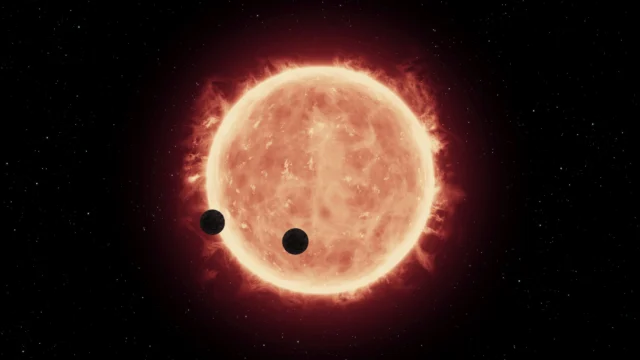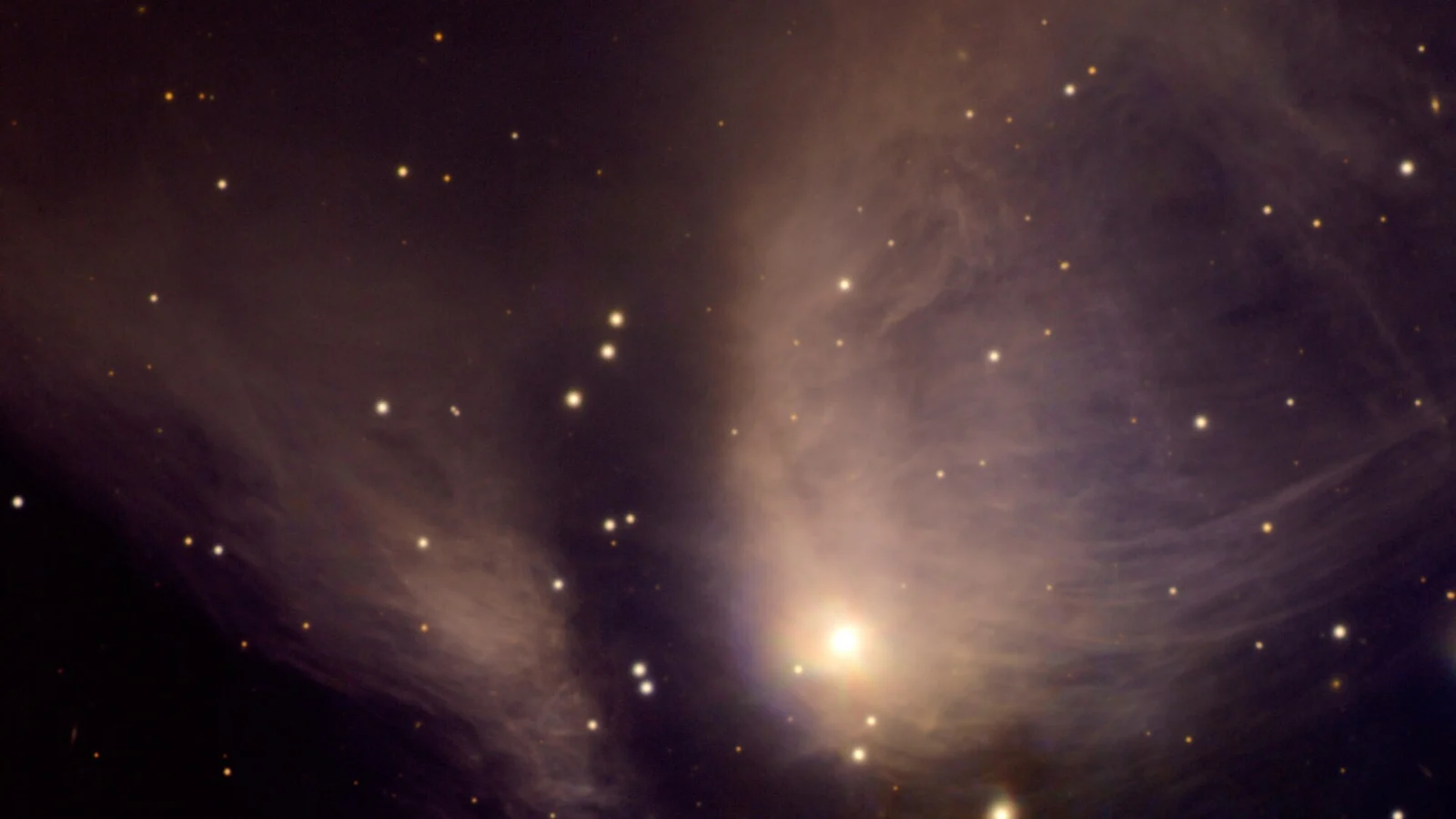
The light from RY Tauri flickers across the void, a dizzying display of stellar instability 450 light years away in the constellation of Taurus. Its brightness shifts wildly, capable of dramatic fluctuations over the span of a mere year, and even larger, irregular brightening events that last for about a month. This young star is not a stable beacon; rather, it is a volatile furnace, constantly altering its appearance as it churns through the complex processes of stellar birth.
This stellar object presents itself as a particularly massive and complex example of a T Tauri star, a type commonly found in stellar nurseries. Situated within the Taurus Molecular Cloud, RY Tauri is far more substantial than its typical counterparts, potentially sitting in an intermediate category between a T Tauri star and a Herbig Ae/Be star. The star is notable because it is captured in a snapshot of stellar evolution, a turbulent phase where the infant star is actively interacting with the raw materials of its birth.
The turbulent beginnings of a stellar giant
The star is shrouded by a vast protoplanetary disk, a massive structure measured at 0.3 solar masses, which is predominantly composed of gas. The existence of this disk itself has been a subject of scientific debate, with some suggesting it may be a remnant of a disrupted birth envelope rather than a stable structure actively forming planets. This disk is the physical stage upon which the star’s dramatic activity plays out.
Furthermore, powerful polar jets have been observed shooting out from the stellar surface. These energetic outflows are not merely stellar winds; they contain detectable quantities of both oxygen and sulfur, providing direct evidence of the star’s incredibly dynamic and violent processes. These jets are mechanisms through which the nascent star sheds excess angular momentum as it begins to solidify its core.
Layers of stellar complexity
Adding to the already intricate picture is the star’s erratic light curve, which varies significantly over time. Henrietta Swan Leavitt first catalogued RY Tauri as a variable star back in 1907, noting its status as a highly obscured Orion variable. Modern observation confirms this variability, showing that the star occasionally shines through inhomogeneities within its inner disk, causing the irregular brightening events.
These irregular episodes can reach a magnitude of one, causing the star to undergo periodic, dramatic shifts in visibility. Over the course of a decade, the overall light curve of RY Tauri can change by between two and three magnitudes, illustrating the sheer unpredictability of its gaseous environment. The star also experienced a gradual brightening trend during the entire span of the twentieth century, suggesting a fundamental shift in the mechanisms driving its stellar output.
Hunting for hidden worlds
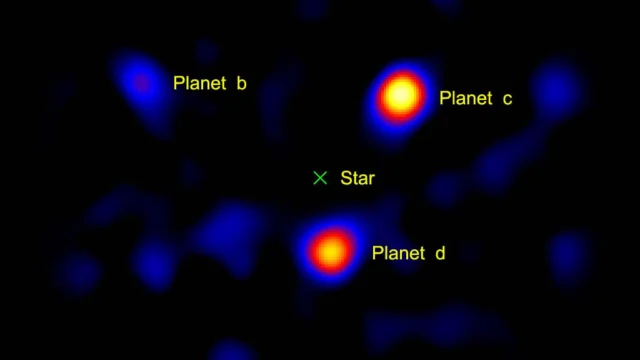
The star’s surrounding environment has led to some of the most surprising discoveries regarding planetary formation. Since 2021, scientists have suspected the presence of a superjovian planet orbiting RY Tauri at a remarkably close distance of 0.2 AU. This speculation arises from the unusual dynamics and characteristics observed around the young star.
The quest for companions has proven fraught with complications. In 2008, a suspected companion object, designated 2MASS J04215810+2826300, was identified, appearing at a projected separation of 1500 AU. However, subsequent analysis using Gaia data definitively proved that this object was merely a background star and had no physical connection to RY Tauri, highlighting the immense difficulty in identifying genuine stellar or planetary partners in such crowded, distant systems.
A window into stellar infancy
RY Tauri remains a critical object for astronomers because it offers a rare, visible look into the tumultuous process of stellar birth. It allows researchers to study how a massive star forms, how it generates powerful jets, and how planetary systems might begin to coalesce within a dense, dusty cloud. The extreme variability and the presence of both massive gas disks and suspected planets make it a key laboratory for understanding early stellar life cycles.
The complexity of this young star—a flickering giant grappling with its own formation—serves as a potent reminder that even the most powerful objects in the cosmos are often shrouded in mystery. The ancient, volatile light of RY Tauri continues to challenge our understanding of stellar drama.
Background: Wikipedia