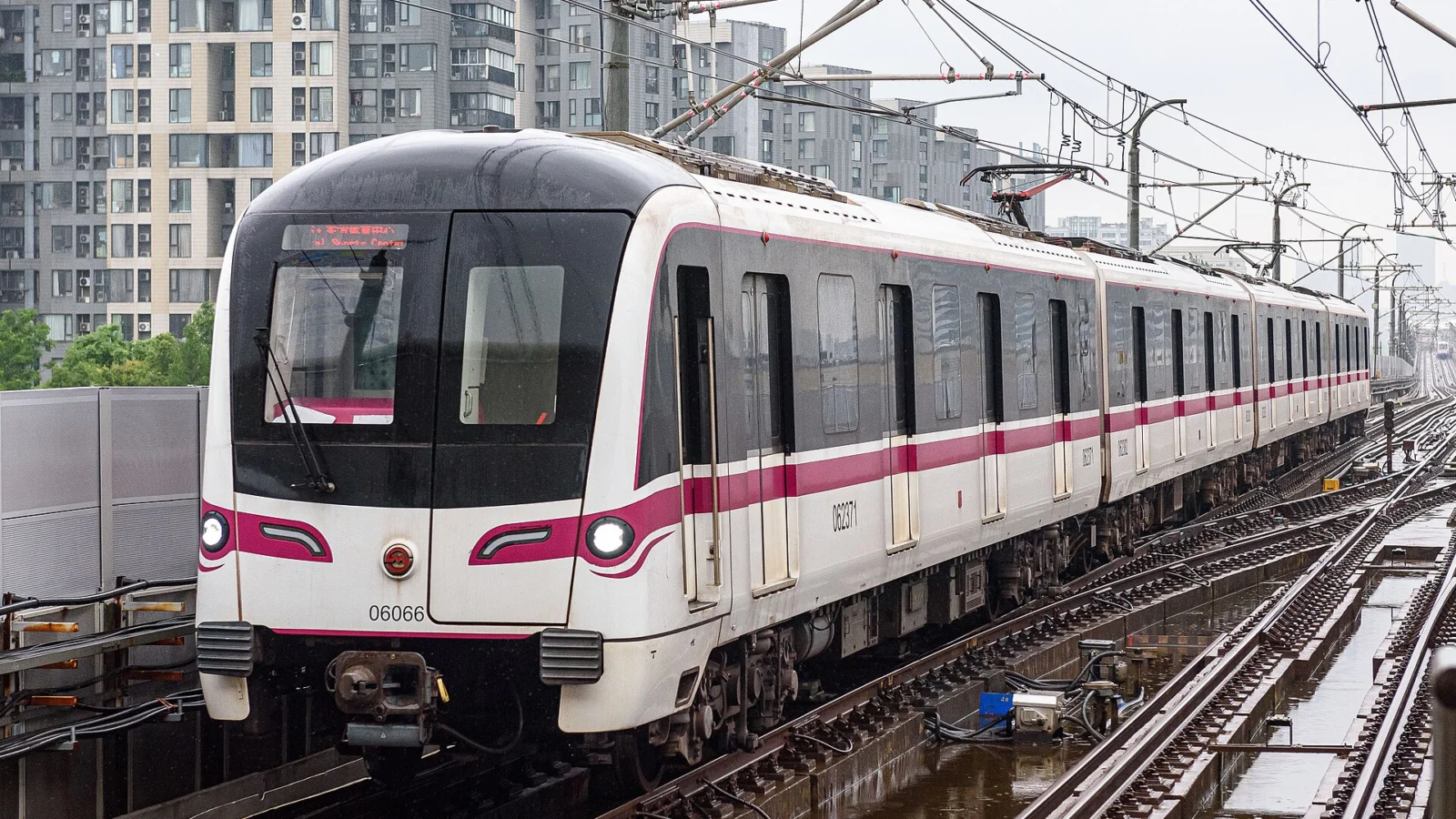
The heavy doors of a narrow train slide shut with a definitive hiss, sealing out the humid air of the Pudong New Area. Inside, the carriage is bathed in a distinct, rosy hue, a visual hallmark that distinguishes this particular artery of the Shanghai Metro. Passengers stand shoulder to shoulder as the train hums, beginning a journey that will take just over an hour to reach the opposite end of the district.
This is Line 6, a vital piece of subterranean infrastructure that serves as a backbone for one of the world’s most rapidly developing urban landscapes. While many metro lines are sprawling networks that crisscross entire provinces, Line 6 is a concentrated force, operating entirely within the Pudong New Area. It is a testament to rapid urban planning, moving thousands of people daily through a corridor that was transformed from a construction site into a bustling transit hub in less than a decade.
A pink ribbon through the city
The genesis of this transit route began in the year 2000, a period of intense expansion for Shanghai’s eastern reaches. Planners envisioned a north-south corridor that would alleviate the pressure on surface transport and provide a reliable pulse for the growing population. The project moved with remarkable speed, culminating in a single-phase opening that delivered a 30-kilometer corridor of rail. On December 29, 2007, the line officially joined the city’s fleet, instantly altering the geography of the Pudong New Area.
The arrival of the metro necessitated a massive overhaul of the local transport ecosystem. To ensure the efficiency of the new rail link, several existing bus routes were either cancelled or diverted from their original paths. This shift was not merely a minor adjustment; it was a fundamental redirection of how people moved through the district. The transition was immediate and high-impact, as the infrastructure was designed to absorb the massive influx of commuters who were previously reliant on slower, surface-level transit.
The “Hello Kitty” and the capacity crunch
Among the commuters, the line has earned a playful nickname: the “Hello Kitty Line.” This is due to its distinctive pink livery, a striking aesthetic choice that stands out against the more standard industrial tones of other metro lines. On official system maps, the line is identified by a bold magenta color, ensuring that even those unfamiliar with the local geography can easily spot its path. Despite its cute nickname, the line serves a serious, high-volume function, moving a staggering number of people through its tunnels every single day.
The scale of its success was almost immediate. During the first few days of operation, the line saw ridership exceeding 150,000 people per day, a figure that blew past the original forecasts. When the project was first conceived, planners expected a daily volume of only 105,000 people. This massive surge in demand forced the municipal government to take swift action, pledging to increase the frequency of trains starting in June 2008. However, the demand continued to climb, reaching a point where the busiest sections of the line were running at 133% capacity by 2012.
Engineering limits and strategic hubs
The constraints of the line’s design have created a unique set of logistical challenges for the city’s transport authorities. Line 6 utilizes narrow-bodied “C size” trains, which consist of four carriages each. These specific trains have a width of 2.6 meters and a length of 19.49 meters. Because of the specific loading gauge of the tunnels, the city cannot use the wider “A size” trains found on other parts of the network. Furthermore, the physical length of the platforms makes it practically impossible to add more carriages to the existing trains to accommodate the overflowing crowds.
To manage the sheer volume of passengers, the line relies on a series of strategic interchanges. Century Avenue serves as a massive hub, connecting passengers to lines 2, 4, and 9. This station was originally known as Dongfang Road before it was renamed on 28 October 2006. Another critical junction is the Oriental Sports Center, which opened in April 2011 to provide a link to lines 8 and 11. This station also underwent a name change, formerly known as Jiyang Road before its renaming on 7 May 2011. Additionally, Gangcheng Road provides a vital connection to line 10, ensuring that Line 6 remains integrated into the wider metropolitan web.
A permanent fixture in the Pudong skyline
The engineering of Line 6 was built for a specific purpose: to move people at a designed speed of 80 km/h. It was a project of precision, designed to handle the specific density of the Pudong New Area without the need for expansion. Today, the line remains a finished masterpiece of urban planning. There are currently no plans to extend the line further, meaning its 30-kilometer reach is a permanent fixture of the city’s layout. It stands as a completed chapter in Shanghai’s transit history, a line that succeeded perhaps too well in its own design.
The legacy of Line 6 is one of unexpected popularity and structural endurance. It proved that even a “narrow” line could become a “wide” success, carrying more people than anyone had dared to predict. It remains a vibrant magenta thread in the fabric of the city, a pink ribbon that never stops moving. The doors slide shut, and the pink train hums into the tunnel.
Background: Wikipedia