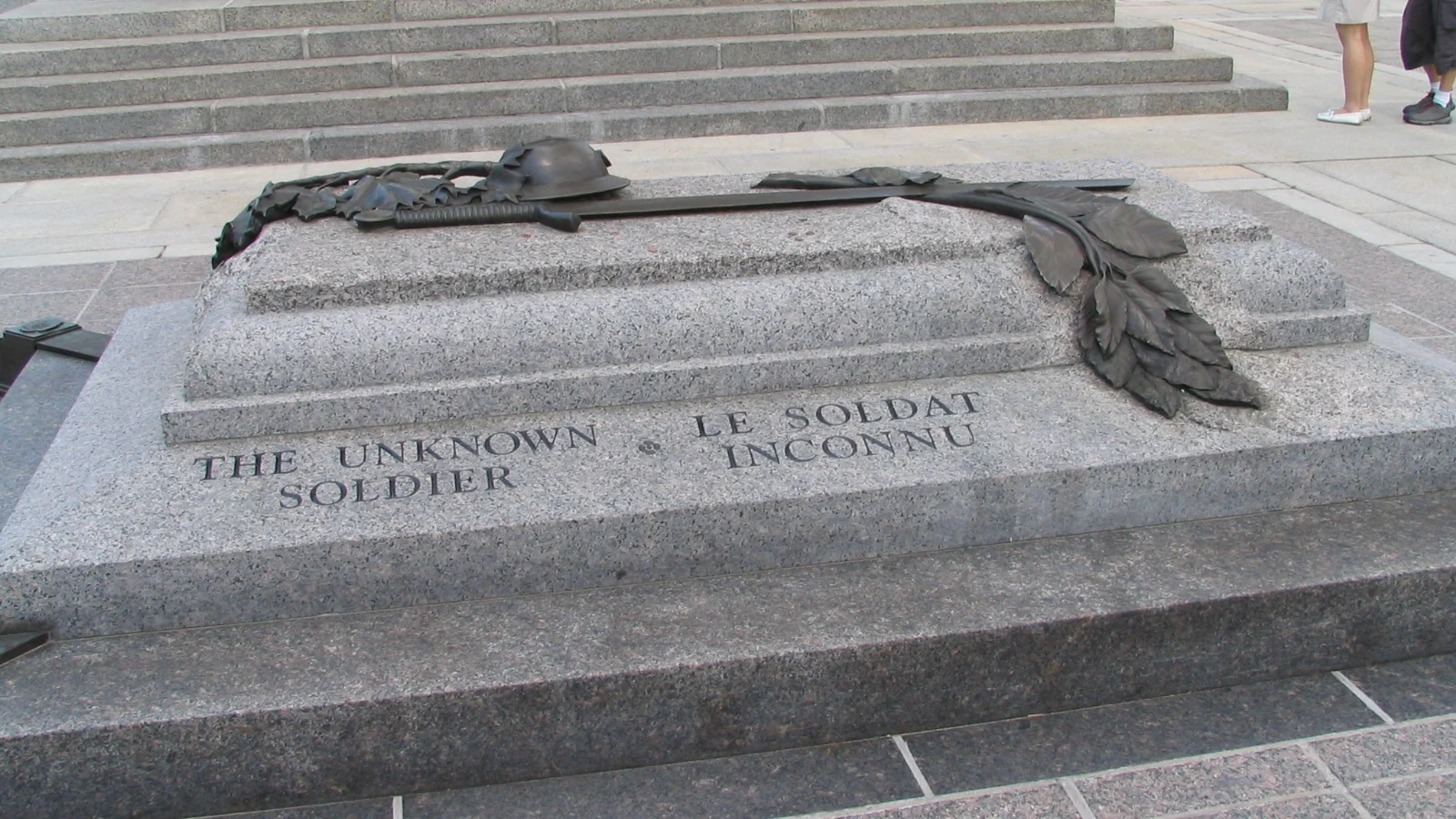
The solemn passage of the casket, draped in dignity, moved through the heart of Ottawa, a procession that commanded the attention of all who witnessed it. At the centre of the ceremony, the representation of a nameless warrior rested, a silent testament to sacrifice made far from home. This poignant journey culminated at the National War Memorial, where an unidentified soldier was finally laid to rest beneath a permanent marker of remembrance.
This monument, the Tomb of the Unknown Soldier, was conceived to serve as a focal point for national grief and enduring gratitude. It was erected to pay respect to Canadian service members whose ultimate sacrifice was made without their identity ever being confirmed. The remains interred within the sarcophagus belonged to a soldier who had perished in France during the First World War, sourced from a Commonwealth War Grave situated near Vimy, France. The scale of the honour paid is vast, as the Tomb commemorates an estimated 116,000 Canadians who lost their lives in combat, while also extending its respect to every member of the Canadian Armed Forces, regardless of when they served.
Read more: Unknown soldier memorials: A history of remembrance
The genesis of a lasting tribute
The entire undertaking originated with the Royal Canadian Legion, who spearheaded the initial vision for this memorial. This foundational project later received support from the Canadian government through the Canada Millennium Partnership Program, lending institutional weight to the cause. The process of selecting the actual grave site was entrusted to the Commonwealth War Graves Commission, which ultimately designated the grave located at Grave 7, Row E, Plot 8, within the Cabaret-Rouge British Cemetery in Souchez, France. This specific location held deep resonance, as the Vimy Ridge site was the setting for the first major battle involving all four Canadian divisions.
The physical retrieval of the remains was a carefully managed affair. The unknown soldier’s remains were exhumed on May 16, 2000, and subsequently flown to Ottawa on May 25, 2000. Before the final interment, the body lay in state for a period of three days within the Hall of Honour, located in the Centre Block of Parliament Hill. The formal transport of the remains occurred on May 28, 2000, aboard an RCMP gun carriage, forming a respectful funeral cortege that included figures such as Adrienne Clarkson, Jean Chrétien, and various veterans alongside the police escort.
The artistry of remembrance
The structure housing the unknown soldier is a significant piece of national artistry, designed to evoke powerful historical and emotional connections. Its dimensions measure 3.5 metres in length, 2.5 metres in width, and 1 metre in height, and it is constructed from Caledonia granite. The decorative elements are handled with meticulous care; intricate bronze work by Mary-Ann Liu incorporates symbols such as a sword, a World War I helmet, and the maple and laurel leaves.
Further enhancing the memorial’s historical depth are the corner pieces, which feature variants of the Memorial Cross dedicated to George V, George VI, and Elizabeth II. The overall design was influenced by the established aesthetic of the Vimy Memorial, an artistic style developed by Walter Seymour Allward. These details ensured that the monument spoke a language of honour understood across different eras of Canadian history.
The enduring weight of duty
The commemoration is not merely a static display; it involves active, daily observance of duty. Since 2007, sentries have been posted at the tomb, maintaining a rotation schedule from 9 am until 5 pm. These sentries represent the breadth of the modern military, drawing personnel from every branch, including the Army, Navy, Air Force, and Special Operations Command.
Despite its solemn purpose, the memorial has been the site of both poignant moments and unfortunate incidents. In 2014, a man discharged a weapon at the sentries, resulting in the fatal wounding of Corporal Nathan Cirillo. More recently, the site became the flashpoint for a different kind of demonstration when protestors danced atop the tomb during the Canada convoy protest weekend of January 29, 2022.
The meaning echoed across the nation
The symbolism embedded within the Tomb is profound, representing a collective commitment to those who served. The ceremony of the re-interment saw the Legionnaires carefully placing soil sourced from every Canadian province and territory upon the casket, binding the nation together in memory. The monument serves to honour not only the unidentified fallen but also the entire history of service, both past and future.
The existence of this memorial, and its recent iteration in St. John’s, Newfoundland and Labrador—which installed a similar tribute in June 2024 to hold the remains of a Royal Newfoundland Regiment soldier—demonstrates the enduring reach of this national sentiment. The meticulous maintenance of the site by Public Works and Government Services Canada underscores its continued importance to the national consciousness. The memory of the unknown soldier remains a potent reminder that sacrifice echoes across generations. The solemn passage of the casket, draped in dignity, moves through the heart of Ottawa, a silent testament to sacrifice made far from home.
More from Ungrid Now
- Sealed by Silt: The Untouched Royal Cache of Sithathoriunet
- Santa Maria La Nova: Naples’ Stone Testament to Faith and Mystery
Background: Wikipedia