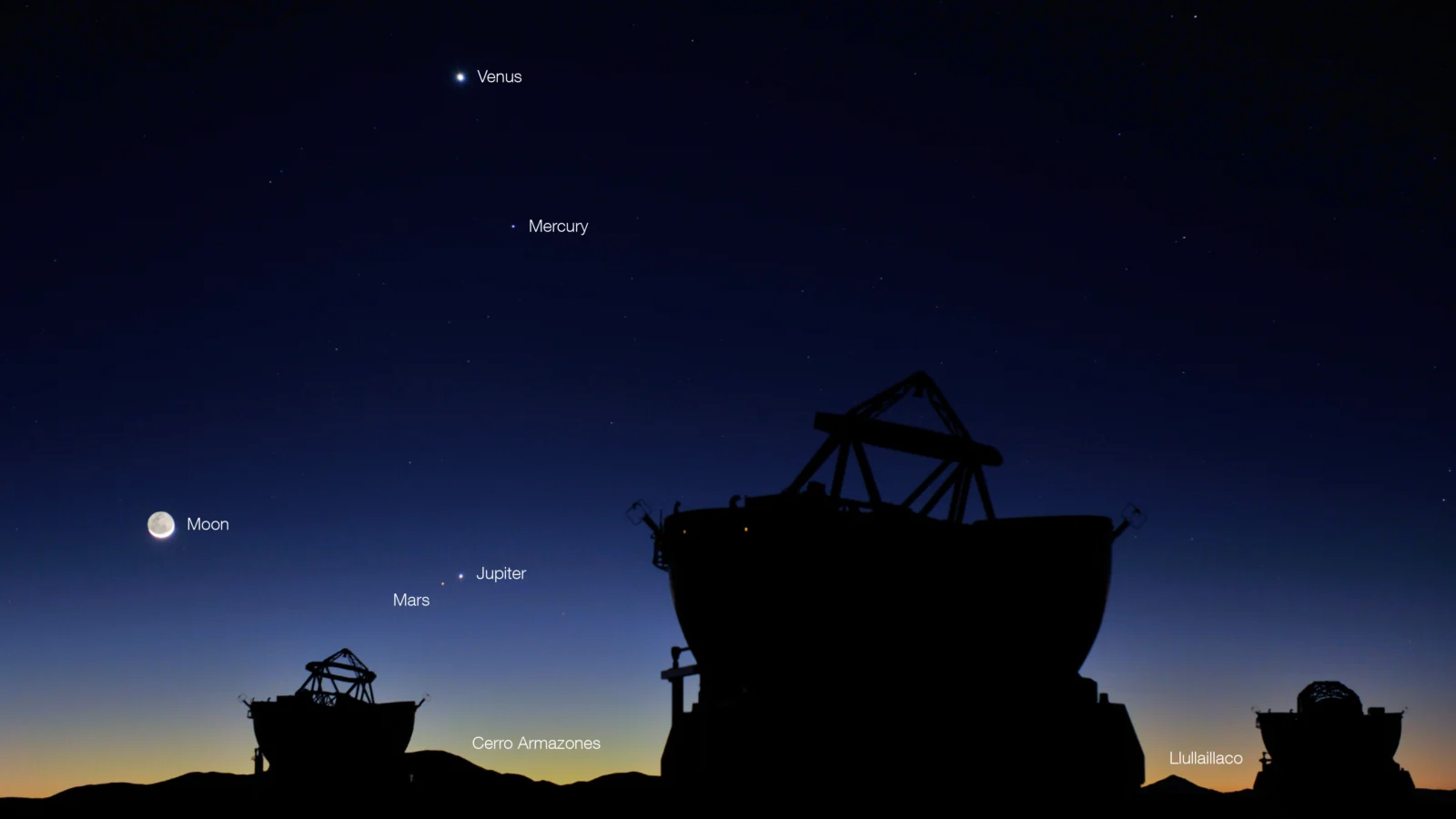
The celestial canvas overhead offers a subtle, yet striking spectacle this week. As the Earth turns, observers can witness the delicate shifting light upon our nearest neighbour, the Moon. This particular evening, the Moon presents itself as a slim, illuminated crescent, promising a fascinating glimpse into lunar geography.
On Sunday, November 15, 2026, the Moon is currently in the Waxing Crescent phase, meaning that 30% of its surface is visible to those looking up. The Moon completes its entire cycle, from new moon to new moon, in roughly 29.5 days. This phase is notable because, for observers in the Northern Hemisphere, the small sliver of light is visible on the right side of the lunar disc. NASA’s Daily Moon Guide tracker serves as a reliable resource for tracking these constantly changing lunar phases.
Unpacking the lunar illumination
The changing appearance of the Moon is not random; it is a direct result of the way sunlight reflects off its surface. As the Moon orbits Earth, the amount of sunlit side we can view changes, dictating the various eight phases. These stages include the dark New Moon, the growing Waxing Crescent, and the completely bright Full Moon. The New Moon occurs when the Moon is positioned between the Earth and the Sun, rendering it invisible to us.
The lunar cycle is a continuous progression through distinct phases. Following the Waxing Crescent, the Moon progresses to the First Quarter, where exactly half of the Moon is illuminated on the right. Subsequently, the illumination expands further into the Waxing Gibbous stage, signifying that more than half of the face is now bathed in sunlight.
Peering into the lunar terrain
While the overall shape of the Moon is captivating, its surface features offer a wealth of detail for keen observers. Without any optical assistance, casual Moon gazers can easily spot prominent features such as Mare Crisium and Mare Fecunditatis. These large, ancient plains provide a dramatic backdrop for the celestial viewing experience.
For those willing to bring out binoculars or a telescope, the lunar landscape becomes even more intricate. These aids allow viewers to clearly discern specific geographical formations like Endymion Crater and Posidonius Crater. Even more dedicated astronomers can use a telescope to view Mare Nectaris, which requires a higher degree of magnification to be seen. Furthermore, telescopes are powerful enough to reveal the precise locations of both the Apollo 11 and Apollo 17 landing spots.
What the next cycle holds
The current Waxing Crescent phase is just one snapshot in a grand, celestial narrative, and the journey continues. The Moon will continue its growth towards its next major illuminated event. The next time the Moon will be completely full, marking the culmination of this current cycle, is scheduled for November 24.
As the Moon moves away from full illumination, it will begin the process of waning, transitioning through Waning Gibbous and eventually reaching the Third Quarter. The Waning Crescent, a thin sliver of light visible on the left side before total darkness, marks the end of the visible cycle. As one observer noted, “There’s a little more to see on the Moon tonight.” The lunar face continues its ancient, majestic dance, reminding us that even the smallest sliver of light holds vast cosmic secrets.
Source: Mashable