A cold, silent void stretches between the stars, housing worlds that have never felt the warmth of a human sun. Somewhere in that vast expanse, a sphere of rock or gas might be spinning in a perfect orbit, completely unaware of our gaze. These are the exoplanets, the celestial orphans of the cosmos, drifting in systems far beyond the reach of our own Solar System.
The discovery of these distant worlds represents one of the most profound shifts in modern astronomy. For centuries, humanity looked at the night sky and assumed our own arrangement of planets was the standard for the universe. The confirmation that other stars host their own planetary families has shattered that solitude, revealing a galaxy teeming with diverse, alien architectures. It is a monumental leap from observing the familiar to cataloguing the infinite.
The first steps into the unknown
The journey to find these worlds began with a series of hard-won victories in the late twentieth century. The very first confirmed detection of an exoplanet occurred in 1992, but it was not orbiting a sun-like star; instead, it was found circling a pulsar. This was a landmark moment that proved planets could exist in the most extreme environments imaginable. It wasn’t until 1995 that scientists successfully detected the first exoplanet orbiting a main-sequence star, opening the door to the search for worlds more similar to our own.
The history of these discoveries is often filled with retrospective surprises. A planet first detected in 1988 remained in a state of limbo for years before it was officially confirmed in 2003. Even further back, the timeline of discovery stretches into the past; evidence of an exoplanet was first noted in 1917, though it was not recognised as a precovery until 2016. These milestones show how our ability to interpret the data from the heavens has evolved, turning ancient signals into modern discoveries.
The tools of the trade
To find a needle in a cosmic haystack, astronomers rely on two primary methods: transit photometry and Doppler spectroscopy. Transit photometry involves watching for a slight dip in a star’s brightness, which suggests a planet is passing in front of it. Doppler spectroscopy, on the other hand, looks for the “wobble” of a star caused by the gravitational tug of an orbiting body. These methods have allowed us to build an incredible catalogue of the cosmos, though they currently have a bias toward finding large planets that sit very close to their parent stars.
The diversity of these worlds is staggering, ranging from the tiny to the gargantuan. Draugr holds the title of the least massive known exoplanet, possessing only twice the mass of our Moon. At the opposite end of the spectrum sits HR 2562 b, a behemoth that sits on the NASA Exoplanet Archive as the most massive exoplanet known. This massive world is approximately 30 times the mass of Jupiter. Because some definitions classify objects over 13 Jupiter masses as brown dwarfs, the line between a planet and a failed star can be blurry. “The fact that there is no special feature around 13 MJup in the observed mass spectrum reinforces the choice to forget this mass limit” — Extrasolar Planets Encyclopaedia.
A galaxy teeming with life
As of 5 November 2026, the tally of confirmed exoplanets has reached 6,464, spread across 4,849 different systems. This data reveals that planetary systems are often crowded; 1,074 of these systems contain more than one planet. Perhaps most exciting is the potential for habitability. It is estimated that about 1 in 5 Sun-like stars may host an Earth-sized planet within its habitable zone. When you scale this up to the entire Milky Way, the numbers become dizzying, with an estimated 11 billion potentially habitable Earth-sized planets.
If we expand our search to include red dwarfs, that number of potentially habitable planets could soar to 40 billion. Furthermore, we are not limited to our own galaxy; evidence now exists for extragalactic planets located in other galaxies entirely. Even those without a home star are accounted for, as “rogue planets” drift through the void without orbiting any host. The Milky Way may contain billions of these lonely wanderers. This vastness ensures that the search for a “second Earth” is a quest of staggering proportions.
The naming of new worlds
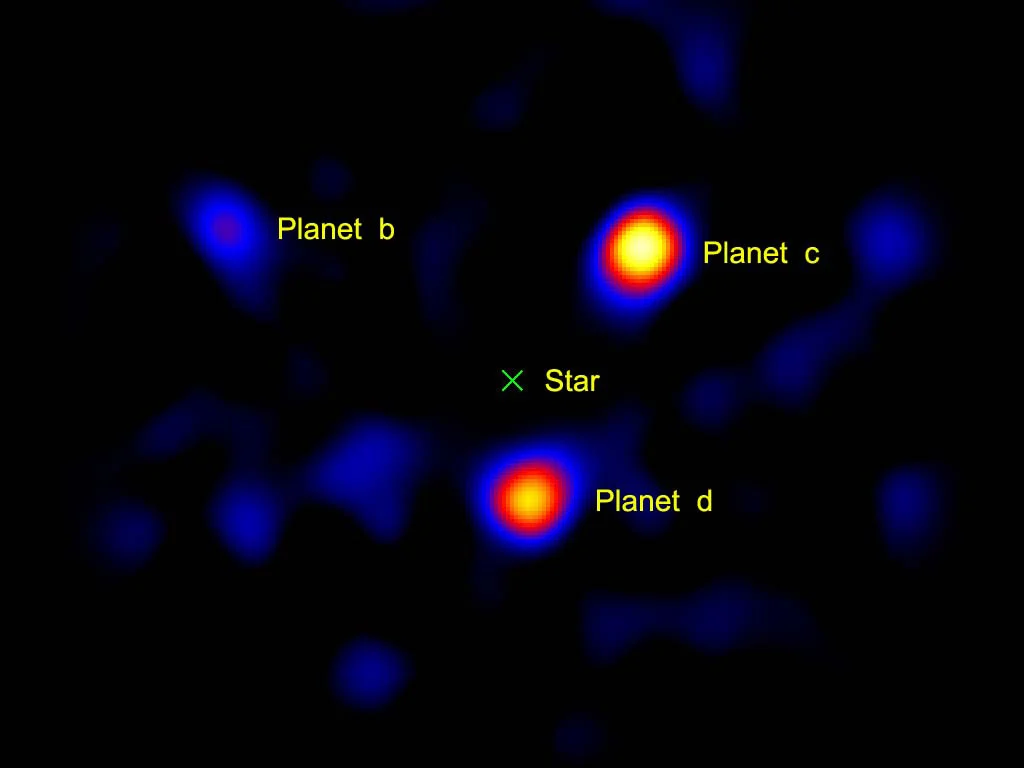
Because the International Astronomical Union (IAU) definition of a planet does not apply to exoplanets, these worlds follow their own naming conventions. They are identified by adding a lowercase letter to the name of their parent star. In this system, the first planet discovered in any given system is always designated with the letter ‘b’. This naming convention provides a structured map for a chaotic and expanding universe of discovery.
The future of this field lies in deeper observation and more precise data. The James Webb Space Telescope is set to play a pivotal role, tasked with studying the composition and habitability of these distant spheres. By peering into their atmospheres, we may finally learn what these worlds are made of and if they could support life. We are moving from merely knowing they exist to understanding what they are.
The study of exoplanets reminds us that we are part of a much larger, more populated cosmos than we ever dared to imagine. From the massive HR 2562 b to the tiny Draugr, every discovery brings us closer to understanding our own place in the stars. We are no longer looking at a lonely void, but a crowded neighborhood. A sphere of rock or gas might be spinning in a perfect orbit, completely unaware of our gaze.
Background: Wikipedia