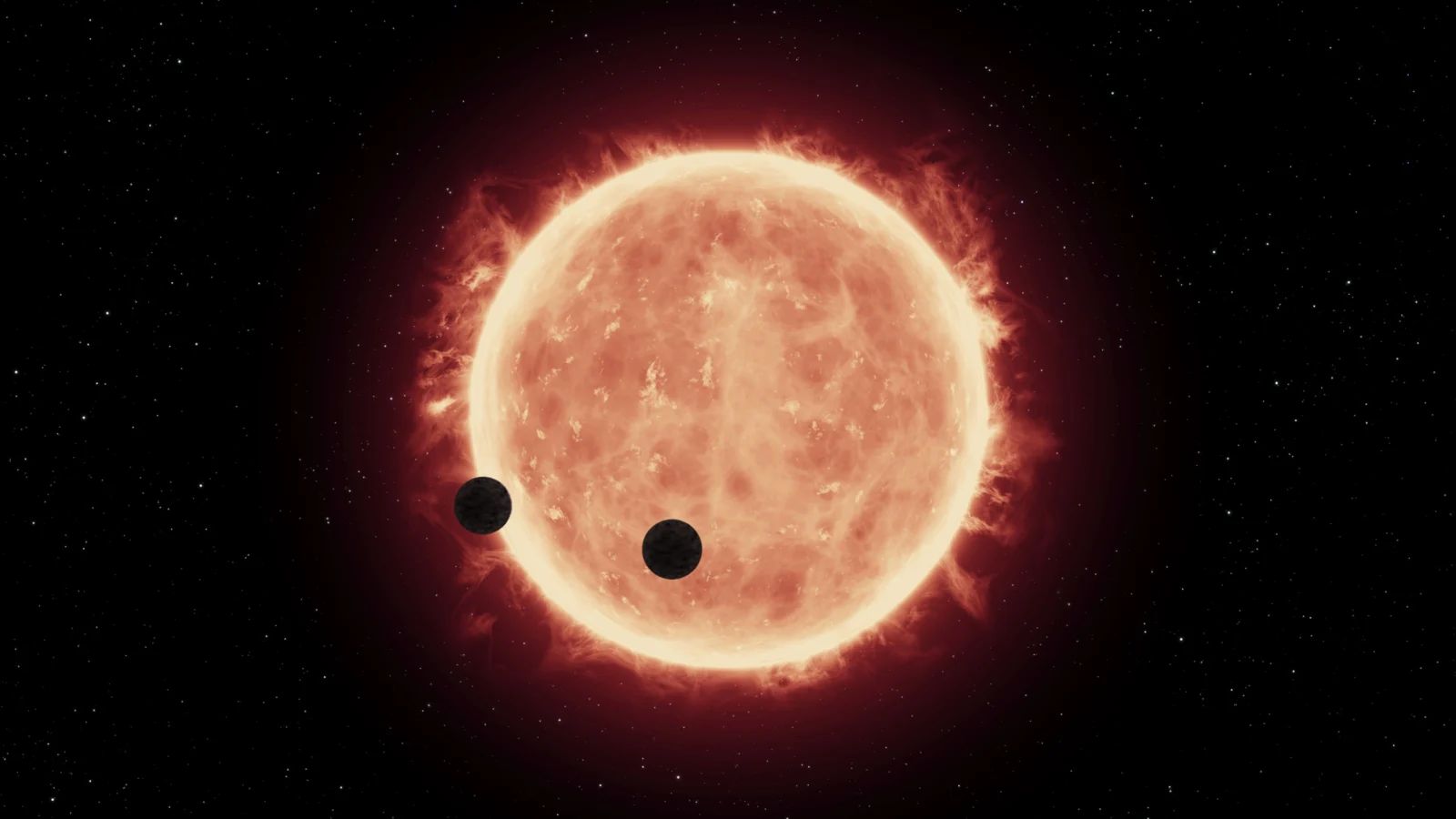
The faint, ruddy glow of VB 10 has been a silent fixture in the vast expanse of the constellation Aquila for decades, a tiny, dim ember barely visible from Earth. It resides in a binary relationship, a secondary star orbiting a more substantial companion, yet its true nature is far from simple. This minuscule red dwarf, located approximately 19 light-years away, presents a celestial anomaly—a benchmark of stellar minimalism, possessing properties that challenge common understanding of cosmic formation.
This particular star is remarkable not just for its diminutive size, but for its role as a key reference point in astrophysics. It was historically regarded as the least luminous and least massive star known, a stellar ghost barely holding itself together. Though this record was later superseded by LHS 2924, VB 10 remains a primary standard for the M8V spectral class, offering astronomers a specific template for understanding the lowest end of the stellar mass spectrum. Its own mass is incredibly low at 0.08 solar mass, placing it dangerously close to the theoretical limit of stellar existence.
The discovery of a stellar footnote
The existence of this dim star emerged from a routine search for stellar companions. In 1944, George Van Biesbroeck was using the 82-inch Otto Struve reflector telescope, surveying the area around Gliese 752 (also known as Wolf 1055) to look for any accompanying stars. During this meticulous survey, he identified VB 10, noting its presence and subsequently documenting it.
Upon discovery, the star was recognized as part of a bound binary system. While VB 10 is the secondary component, the primary star is Gliese 752, leading to the formal designation Gliese 752 B. The two stars maintain a separation of about 74 arcseconds, which equates to roughly 434 AU. This pairing established a complex stellar arrangement, where one star was perpetually shadowed by the gravitational and physical presence of its larger partner.
The volatility of a tiny world
Despite its unassuming red colour, VB 10 is anything but placid. It is classified as a variable star, identified specifically as V1298 Aquilae, meaning its brightness is subject to changes. These variations are characteristic of a UV Ceti-type star, a type known for its violent, unpredictable behaviour.
Its surface conditions are highly unstable. Under normal circumstances, the star maintains a surface temperature of 2,600 K. However, it is prone to frequent and dramatic flare events, where its temperature can surge dramatically, reaching a startling 100,000 K. This extreme volatility makes it a fascinating subject for studying the energetic outputs of low-mass stars.
The hunt for a missing world
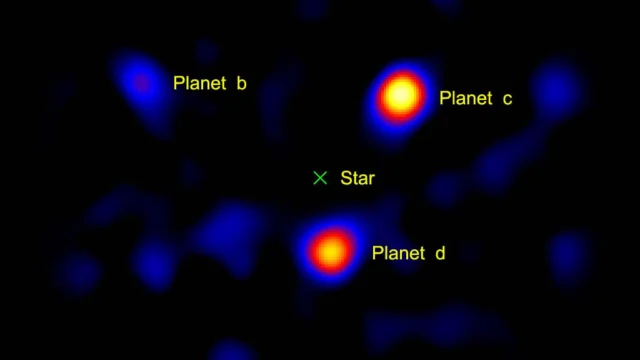
The star’s ancient, dim nature was dramatically complicated in May 2009 with the announcement of evidence suggesting the presence of a planet orbiting it, designated VB 10b. This claimed celestial body was reported to possess a mass six times that of Jupiter, and its predicted orbital period was approximately 270 days.
However, the astronomical investigation into this new planet quickly encountered significant resistance. Subsequent attempts using Doppler spectroscopy, a technique designed to measure radial velocity variations caused by orbiting bodies, failed to detect the expected shifts in the star’s light. The presence of the planet remained unconfirmed despite the initial announcement.
A shift from planets to dust
As the search for VB 10b continued, the scientific community began to pivot its focus away from a planetary body and towards an alternative explanation for the observed signals. By 2016, suspicion grew that the mysterious observations were not caused by a planet, but rather by an asymmetric debris disk signal. This shift in theory suggested that the faint signals were instead originating from a ring of stellar debris orbiting the star.
The ongoing study of VB 10 represents a classic example of how scientific certainty is constantly challenged and refined. From its initial classification as a stellar benchmark to its brief association with a Jovian-sized planet, the star has served as a complex laboratory for testing the boundaries of stellar physics.
Today, VB 10 continues to matter because it forces astronomers to grapple with the limits of detection and the ambiguity of faint signals. It illustrates the inherent uncertainty in observing the deep cosmos, where a flicker of light can represent anything from a planetary world to a ring of ancient dust. It remains a silent, dim ember in Aquila, constantly threatening to erupt in flares, reminding the universe that even the smallest things can hold the most dramatic secrets.
Background: Wikipedia