The heat shimmering off the launch pad at Cape Kennedy, Florida, was a tangible weight against the towering rocket. Inside the payload, the small, octagonal prism of Explorer 33 waited, a delicate scientific instrument poised for its journey into the void. Designed to map the distant dance of the Moon, this spacecraft represented a significant pivot point in NASA’s ambitious space exploration agenda. Its mission was a high-stakes wager, aiming to provide crucial insights that would support the monumental Apollo program.
This small satellite, also known by the designations IMP-D and AIMP-1, was far more than a simple addition to the Interplanetary Monitoring Platform series; it was a conceptual leap. As the fourth satellite in the series, its creation marked a deliberate departure from its predecessors, IMP-A through IMP-C, signaling a new phase in how humanity monitored the solar system. Its primary directive was highly specific: to assist the Apollo mission by precisely studying lunar distances, a task requiring meticulous data gathering from deep space.
The velocity of fate
The journey began on 1 July 1966, when the spacecraft was launched from Cape Kennedy. The mission was fundamentally dedicated to the scientific exploration of space, designed to collect data on the surrounding cosmic environment. However, the launch itself carried an unforeseen complication: an excess velocity of approximately 21.3 m/s directed toward the Moon. This slight but critical deviation proved to be the defining technical hurdle of the entire mission.
This excess speed meant that the spacecraft could not achieve its intended lunar orbit insertion. The planned trajectory was disrupted almost immediately upon leaving Earth’s gravitational influence. Despite this initial failure to establish the precise orbit it was designed for, the mission itself did not fail. The instruments aboard Explorer 33 continued to gather vital information, demonstrating the resilience and robust nature of the scientific payload.
Deep space architecture
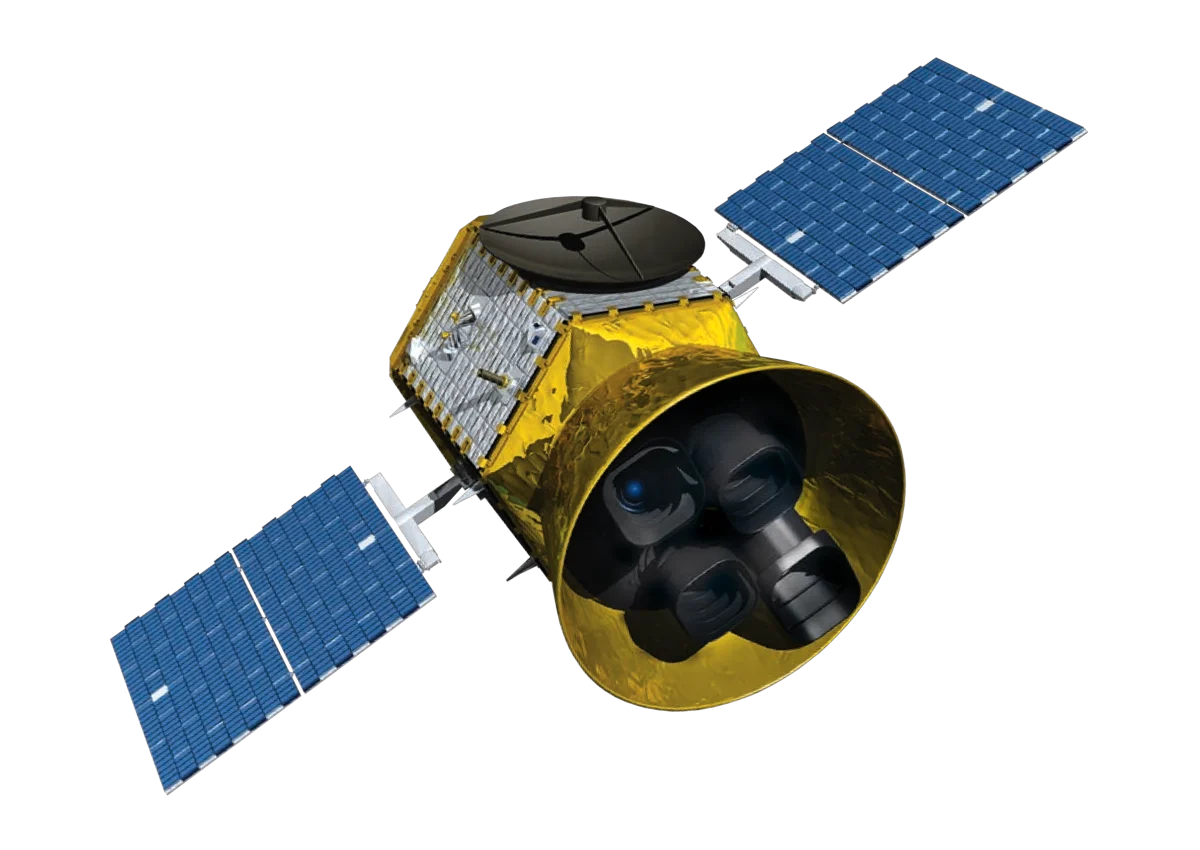
The structure of the spacecraft was meticulously engineered for longevity and function in the harsh environment of space. Its main body was a distinct octagonal prism, measuring 71 cm across and 20.3 cm high. Powering its sophisticated operations were four n/p solar cell arrays, which were capable of generating an average output of 43 watts. Bolted atop the main bus was a 35.8 kgf thrust retrorocket, providing necessary maneuvering capability.
The design was not built for a solitary existence. Explorer 33 was the first of two “Anchored IMP” spacecraft, with its companion, Explorer 35 (also known as AIMP-E, AIMP 2), operating alongside it. The spacecraft was equipped with seven dedicated scientific experiments, amongst which were two fluxgate magnetometers. These instruments allowed the platform to probe the subtle energies and fields that govern the solar system.
A tapestry of measurement
The true measure of the mission lay in the diverse array of data it collected concerning the universe’s most volatile elements. The spacecraft was specifically instrumented to meticulously study plasma, magnetic fields, and solar X rays. One of the initial systems, the ion chamber, performed flawlessly, operating normally from the moment of launch all the way through 2 September 1966.
The long-term scientific payoff came from the specialized instruments. The GSFC Magnetometer continued its work faithfully until 10 October 1968, mapping the ambient magnetic environment. Furthermore, the Plasma Probe experiment provided extraordinary insights into energetic charged particles, specifically measuring electrons, protons, and alphas. This instrument remained operational for an impressive duration, lasting until 21 September 1971.
Legacy beyond the trajectory
The success of Explorer 33 highlights a crucial principle in high-stakes engineering: mission objectives can be achieved even if initial parameters fail. The fact that the spacecraft managed to accomplish its primary goals, despite the excess velocity preventing the planned lunar orbit, solidified its status as a scientific triumph. The data collected offered invaluable knowledge about the space plasma and magnetic structures that influenced the Moon’s environment.
The mission contributed to a deeper understanding of how solar activity impacts the inner solar system. The combination of data gathered by the fluxgate magnetometers and the plasma probe provided detailed information on the movement of energetic charged particles. This knowledge helped refine models of interplanetary space, which was vital for future deep-space missions.
Today, the legacy of Explorer 33 serves as a powerful reminder that scientific perseverance often defies initial setbacks. It stands as a testament to the fact that a small, octagonal prism, launched against the pull of gravity, could map the complex, energetic tapestry of the cosmos. Even when the trajectory falters, the true mission continues.
Background: Wikipedia