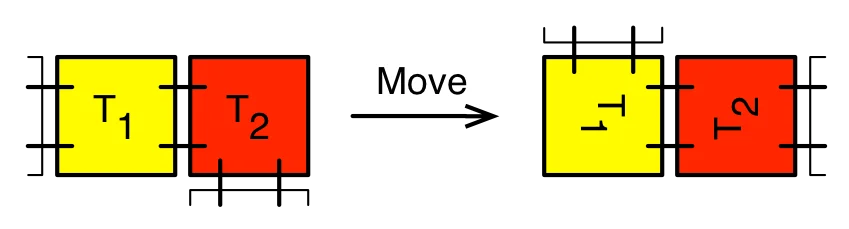
The small, rectangular object lay on the table, a dense grid of folded squares, waiting for a touch. It was a puzzle that seemed to defy simple geometry, a piece of mechanical art where folding and unfolding were as crucial as solving. The goal was not merely to order colours, but to transform its very shape, bending it into a delicate, heart-like form while simultaneously unscrambling the back. This intricate mechanism, known as Rubik’s Magic, represented a fascinating intersection of engineering ingenuity and mental challenge.
This remarkable device, similar in concept to the famous Rubik’s Cube, offered a unique and complex challenge to players. It was designed around a sophisticated system of diagonal grooves that held wires, allowing the entire puzzle to fold and unfurl. The core objective was twofold: manipulate the internal structure of the puzzle and achieve a specific arrangement on its surface. The initial design featured eight black square tiles, establishing the visual foundation of this mechanical marvel.
A mechanical genesis
The creation of this complex puzzle can be traced back to Ernő Rubik. He developed the concept, securing the necessary intellectual property through a Hungarian patent issued on 19 March 1985. His invention gained further international protection with a US patent issued on 11 August 1987. It was through this pioneering work that the puzzle transitioned from a concept to a manufacturable item.
Matchbox eventually began manufacturing the puzzle in the mid-1980s, bringing the novelty to a wider public. The original iteration was constructed in a 2 × 4 rectangle, featuring those initial eight black square tiles. The puzzle’s difficulty was amplified by the immense possibilities inherent in its structure; the 2 × 4 format alone provided thirty-two possible configurations.
The complexity of the shape
The puzzle’s complexity wasn’t limited to its flat configuration. The folding requirement added a layer of structural mystery to the challenge. When solved, the puzzle had to be folded into a heart-like shape, and the back elements had to be unscrambled. This folding mechanism is what separates Rubik’s Magic from simpler spatial puzzles.
Furthermore, the possibilities expanded dramatically when considering the folded state. There were sixty-four possible heart-shaped forms for the puzzle, meaning the solver had to manage both the internal wire structure and the external tile arrangement simultaneously. This depth of complexity made it a highly sought-after object for puzzlers worldwide.
Evolving the challenge
The puzzle underwent several significant changes over its lifespan, adapting to the demands of competitive play and novelty. Initially, the tiles were black, but in 1997, they were updated to red squares accented with goldish rings.
The competitive landscape saw the introduction of more complex versions, notably the Rubik’s Magic: Master Edition, which Matchbox published in 1987. This Master Edition was significantly larger, using 12 silver tiles arranged in a 2 × 6 rectangle. The goal of this advanced version was not a heart shape, but rather folding into a W-like shape, and it later served as an official event component from 2003 to 2012.
The pursuit of perfection
The intense dedication to solving the puzzle led to extraordinary feats of speed. Experienced players demonstrated astonishing proficiency, capable of solving the puzzle in less than two seconds. The pursuit of this mechanical perfection led to official world record milestones. Yuxuan Wang set the benchmark for a single solve at 0.69 seconds, and he also held the record for achieving an average time of 0.76 seconds across five solves.
However, the competitive recognition eventually shifted. The World Cube Association ceased acknowledging Rubik’s Magic as an official event in 2012, marking a turning point in the puzzle’s competitive history. Despite this, the inventive spirit continued, with versions like ‘Create the Cube’ being produced as a ‘Level Two’ puzzle, and even custom versions being built as massive as 2 × 12.
Rubik’s Magic remains a potent symbol of the marriage between complex engineering and human intellect. It is a reminder that the most satisfying challenges often involve transforming something physical, not just arranging it. The quiet click of the tiles, the transformation from rectangle to heart, continues to beckon those who seek mastery over mechanical chaos.
Background: Wikipedia