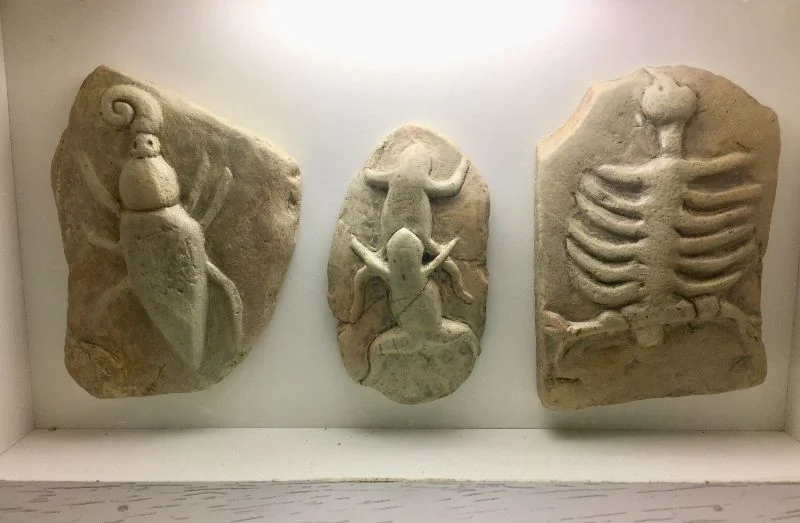
The limestone fragments lay scattered across the landscape, seemingly ancient and utterly bizarre. These pieces, carved into the grotesque shapes of lizards, frogs, and spiders, were initially hailed as profound scientific finds. They were presented as fossil evidence of a hidden prehistoric world, a revelation that seemed too extraordinary to be true. Yet, beneath the veneer of academic discovery, a brilliant and devastating deception was unfolding.
These stones, known as Beringer’s Lying Stones, represented a spectacular intersection of scientific ambition, academic rivalry, and outright fraud. They were pieces of limestone, meticulously carved into fictitious animal forms, and their supposed existence challenged the contemporary understanding of geology. Their purported discovery in 1725 led to a massive wave of scholarly excitement, setting the stage for a scandal that would irrevocably damage the reputation of the man who first claimed them.
The initial claim and scientific wonder
The initial claim was made by Johann Bartholomeus Adam Beringer, a distinguished figure who held the position of Dean of the Faculty of Medicine at the University of Würzburg. In the early years of the eighteenth century, the scientific community was still grappling with the true nature of fossils, meaning that Beringer’s initial belief that the stones were genuinely fossilised remains was taken seriously. He published his detailed findings in Lithographiae Wirceburgensis in 1726, presenting his hypotheses for the stones’ origin to the world.
Beringer’s examination of the fragments was comprehensive, involving the investigation of various hypotheses to explain their bizarre forms. He not only considered the paleontological explanation, but he also proposed that some of the stones might hold divine significance, suggesting that the inclusion of Hebrew names hinted at a celestial or sacred origin. The stones, and the subsequent publication of his work, quickly established themselves as a major topic of discussion within the burgeoning scientific world.
The truth hidden in plain sight
However, the narrative of discovery proved tragically incomplete. Beringer eventually uncovered the stark reality that he had been the victim of a sophisticated hoax. The deception was orchestrated by two men: J. Ignace Roderique, who was a professor, and Johann Georg von Eckhart, a university librarian. These individuals had painstakingly planted the carved stones upon Mount Eibelstadt, creating the illusion of a natural geological occurrence.
The motive for this elaborate prank was rooted in academic animosity, specifically targeting Beringer’s perceived arrogance. The hoaxers added inscriptions to the stones, including the Hebrew name of God, to lend an air of profound mystery and religious weight to the fragments. In court, one of the perpetrators testified to the motive, stating flatly, “he was so arrogant and despised us all.”
The fallout and lasting consequences
The ensuing legal action was swift and brutal, leading to severe consequences for those involved. Beringer successfully took legal action against the hoaxers, ultimately winning the case. Yet, the victory was profoundly bittersweet for him; his professional reputation was forever marred by the association with the fraudulent stones.
The repercussions for the perpetrators were equally severe. Roderique was formally banished from Würzburg following the legal proceedings, while Eckhart lost his post and all associated privileges within the university. The stones themselves, having served their purpose in the great deception, now reside in prominent collections, currently being displayed at the Oxford University Museum, with a few copies also held at Teylers Museum in the Netherlands.
A timeless lesson in perception
Even decades later, the story continues to evolve. A book published in 2005 introduced a fascinating secondary theory, suggesting that perhaps Beringer himself might have been involved in the fraud. This raises the complex question of how much of the scientific narrative is built upon flawed premises or motivated misjudgment.
The Lying Stones remain a potent, strange reminder of the gulf between perception and reality. They illustrate how a profound scientific mystery, born of genuine curiosity, can be entirely fabricated by human spite. They prove that sometimes, the most astonishing finds are not discovered in the ancient strata, but engineered by the pettiness of men.
Background: Wikipedia