The market seemed to defy gravity in mid-2025, a dizzying ascent where technological promise translated into staggering valuation. In July, the stock price of Nvidia soared to a market value of $4 trillion, a quadrupling of its worth since 2023. By October, this valuation had surpassed $5 trillion, a figure that dwarfed the Gross Domestic Product of many nations. This explosive growth was fuelled by the AI boom, a seismic period of investment that fundamentally reshaped global finance.
This sudden, massive surge represented more than just a cyclical tech upturn; it was a fundamental shift in how capital was deployed and perceived across the global economy. The sheer speed and scale of the investment were unprecedented, leading some commentators to describe the AI boom as “the biggest economic bet in U.S. history.” While the potential upside was immense, the market’s exuberance quickly gave rise to concerns over whether this rapid expansion was sustainable, setting the stage for a potential financial correction.
The early sprint to supremacy
The initial phase of the AI boom saw investment primarily financed through companies’ own operating cash flow, allowing early pioneers to build their infrastructure and capabilities. This initial capital deployment was quickly followed by a dramatic shift in funding mechanisms. By 2026, the bond market had become the dominant source of capital for AI ventures, complementing commitments reaching as high as $3 trillion.
This intense period of building infrastructure was marked by massive corporate spending. Microsoft, for instance, dedicated nearly $35 billion to AI infrastructure before the close of September. Furthermore, large players like OpenAI committed to an enormous eight-year investment of US$1.4 trillion solely for data centre development. These massive commitments illustrated the depth of the capital flowing into the AI sector, which itself was estimated to comprise 3.6% of the overall gross domestic product.
A concentration of power and unparalleled valuation
The sheer concentration of wealth and market power during this period was perhaps the most striking feature of the boom. In late 2025, the top five corporations held a commanding 30% share of the American S&P 500 index. This consolidation was part of a wider trend where AI-related enterprises accounted for roughly 80% of the total gains witnessed in the American stock market during 2025.
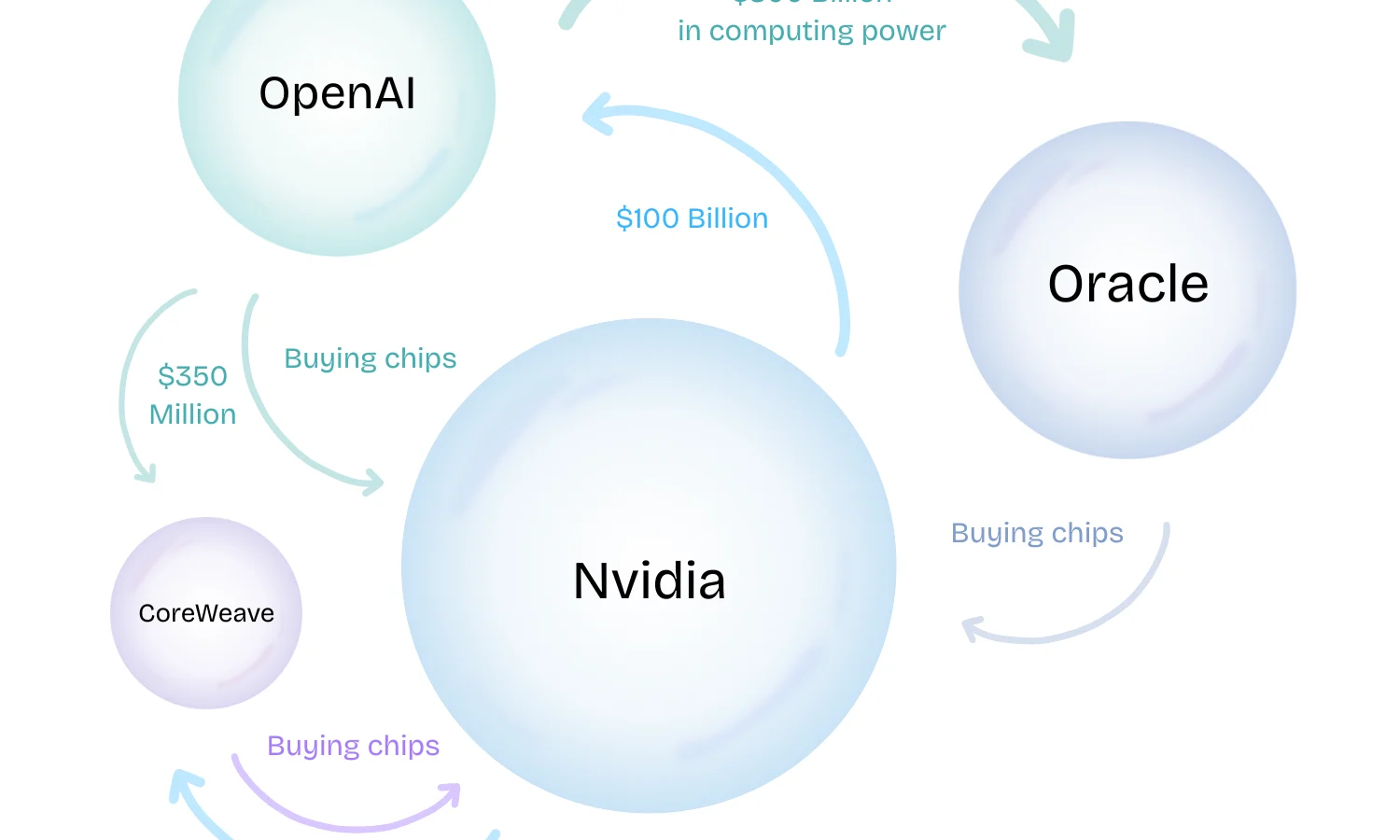
The market’s valuation metrics painted a picture of extreme optimism, suggesting that investors were willing to pay steep premiums for future growth. The S&P 500 traded at 23 times forward earnings, and the Shiller price-to-earnings ratio for the US market crossed the 40 mark. Adding to the growing sense of speculative mania was the observation that circular investments were occurring, a pattern reminiscent of the build-out seen during the dotcom era of the 1990s.
The warnings and the sudden shift
As the bubble inflated, prominent voices began raising alarms about the unsustainable nature of the growth. Hedge fund manager Ray Dalio noted the strong parallels between the current AI development and the previous dot-com cycle. Similarly, Jamie Dimon issued a warning, suggesting a heightened probability of a significant stock market drop within a two-year timeframe. The Financial Stability Board also sounded a warning in May 2026, specifically cautioning against potential credit losses within the private credit sector.
The first major tremor appeared in January 2025 when DeepSeek demonstrated performance matching that of expensive, established AI models. This news acted as a catalyst, leading to an immediate and dramatic reaction in the market; Nvidia’s stock subsequently dropped by 17% in a single day. The tremors soon crossed continents, as the South Korean market experienced a crash, with the KOSPI index falling 44% over 40 days. The signal of a more widespread correction came later, as the Chinese STAR50 index dropped 40% since July 2026, clearly indicating a bubble burst.
The enduring shadow of the boom
Despite the sharp downturns in some global markets, the underlying demand for AI computing remained immense. By October 2026, the industry faced a significant challenge as demand for AI infrastructure began to outstrip the available supply, pushing prices ever higher. The initial excitement, the colossal spending, and the high valuations were characterised by a duality, as reflected in the observation that the economic trend “can be virtuous on the upside, and vicious on the downside.”
The narrative of the AI bubble serves as a powerful modern case study in the intersection of innovation and financial excess. It demonstrates how technological breakthroughs can rapidly alter market dynamics, attracting unprecedented levels of capital and creating valuations that defy traditional metrics. The story remains a potent reminder that even the most revolutionary advancements are subject to market forces and the inherent risks of collective exuberance. The market, after all, must balance its promise against the power of the tide.
Background: Wikipedia