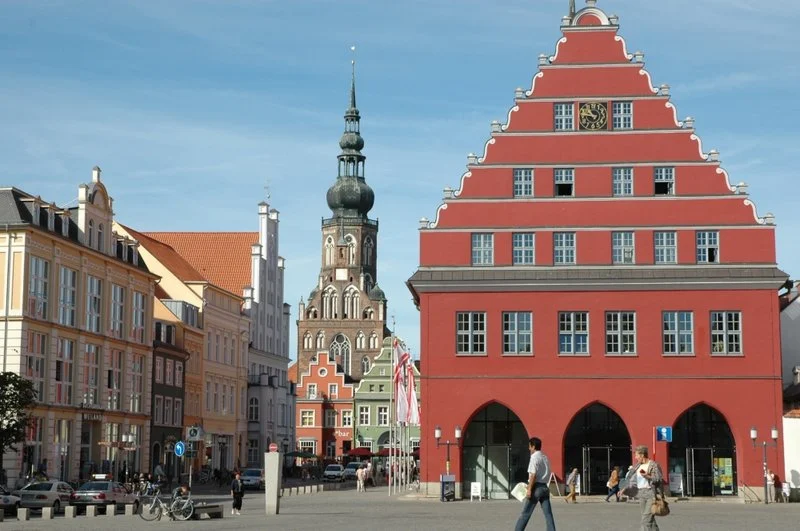
The first stone was laid in the ancient forest, where the name of the settlement translated to “Griffin’s Forest.” From a humble Cistercian outpost, a city of profound intellectual weight slowly began to emerge, eventually securing town privileges under Lübeck law. By the time the city reached its maturity, it was not just a place of trade, but a cradle of learning, hosting a university founded over five centuries before the modern era. This ancient settlement, situated strategically on the River Ryck, has weathered centuries of conquest and change, remaining a steadfast anchor in the Baltic region.
This remarkable city, officially known as the University and Hanseatic City of Greifswald, possesses a unique character defined by its deep historical roots and its sustained commitment to academia. It stands as one of the most venerable institutions in the Baltic Region, having established itself as the second-oldest university after Rostock. Its position, roughly nestled between the islands of Rügen and Usedom, dictated its importance, drawing both trade and scholars to its shores across the centuries.
A deep history of foundational struggle
The origins of Greifswald date back to 1199, when Cistercian monks established the settlement. Over the next decades, it grew, solidifying its status and gaining formal town privileges in 1250. This early period of growth was abruptly challenged by the turbulent tides of European conflict. During the harrowing period of the Thirty Years’ War, the city suffered a catastrophic demographic collapse, seeing its population shrink by two-thirds by 1630.
The fragility of this historical entity was brutally exposed again in the 17th century. In 1627, the city was occupied by Imperial forces, and the conflicts continued until it was subjected to a siege by Swedish troops on June 12, 1631. These events underscore the city’s resilience; despite devastating population losses and military occupation, the core identity of Greifswald persisted, allowing its intellectual and civic life to continue its slow, arduous recovery.
Hidden geographical and demographic shifts
Its location near the Baltic Sea, specifically on the River Ryck, meant that the city’s survival also depended on massive feats of engineering. To protect its populace from the destructive threat of storm surges, the city is guarded by the Ryck Barrier (Rycksperrwerk). This vital piece of infrastructure speaks to the constant negotiation between civilization and the powerful natural forces of the coast.
The city has also undergone dramatic shifts in its modern population profile. In 2021, its population was registered at 59,332, an aggregate number that highlights its unique function as a hub of education and industry. This figure included a significant academic presence, comprising 12,500 students alongside 5,000 university employees. Furthermore, the city has seen its prominence rise regionally, surpassing Stralsund to become the largest city in Pomerania in 2021, cementing its status as a major regional centre.
Adapting to the modern world
The trajectory of Greifswald was irrevocably altered by 20th-century politics. For a significant stretch of time, the city existed as part of the German Democratic Republic (DDR) from 1949 until 1990. The end of this period brought a new chapter to the city’s development, transitioning it into a global player. The city’s modern identity is increasingly linked to large-scale energy and technological projects, drawing attention via BioCon Valley and the presence of the Nord Stream 1 pipeline.
The city also maintains a strong commitment to cultural and academic preservation. It is home to the Pomeranian State Museum (Pommersches Landesmuseum), which serves as a vital repository of the region’s history. The city’s comprehensive governance role is further highlighted by its function as the seat of the district of Western Pomerania-Greifswald, anchoring administrative functions in the locale.
The enduring legacy of learning
Today, Greifswald stands as a powerful confluence of ancient history, cutting-edge science, and regional importance. It is a city that survived devastating wars and political upheavals, always managing to retain its core identity as a centre of knowledge. Its historical significance, dating back to its founding and its status as a major educational hub, provides a rich tapestry against the backdrop of its modern industrial prominence. From the ancient forests to the modern pipeline, the city has demonstrated an astonishing ability to endure. The city of “Griffin’s Forest” continues to teach the world its enduring lessons.
Background: Wikipedia