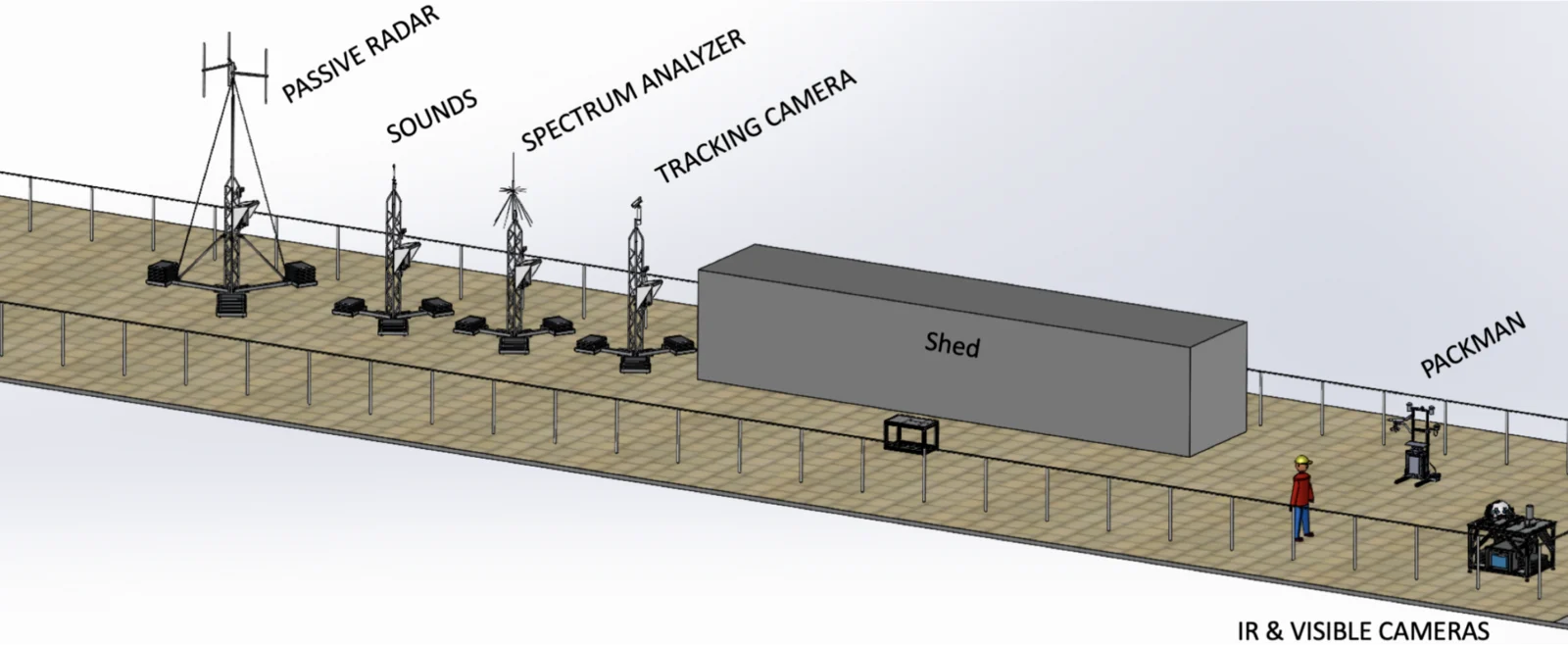
The vast, silent expanse of the night sky suddenly became a place of focused, desperate inquiry. Dedicated sensor systems began gathering data, meticulously logging every flicker, every anomaly in the deep blackness. Over the roof of the Harvard College Observatory, a telescope was installed, a sentinel watching the orbit and the atmosphere with obsessive precision. The search was not merely about spotting lights; it was about finding evidence of intelligence, whether artificial or otherwise, suspended in the celestial currents.
This undertaking, known as the Galileo Project, represented a radical departure from traditional astronomical pursuits. It was conceived as an international scientific initiative, driven by a core mandate: the search for extraterrestrial intelligence or technology. Rather than relying solely on historical theories, the project adopted an agnostic, empirical inquiry, aiming to identify Unidentified Aerial Phenomena (UAPs) and technosignatures using highly optimized, unclassified sensor systems. It was a concerted push to move beyond speculation and into verifiable data collection.
How the project began
The impetus for this ambitious global hunt followed the release of the ODNI UFO report by U.S. Intelligence. This governmental documentation seemed to accelerate a shift in how scientific communities viewed the mysterious objects traversing Earth’s skies. While Bill Nelson, head of NASA, discussed UAP analysis on 3 June 2021, astrophysicist Avi Loeb began his independent work. He initially corresponded with NASA via email on 5 June, but ultimately launched the Galileo Project on 26 July 2021.
The initiative was founded by Avi Loeb, a Harvard University astrophysicist, and was established as a non-profit scientific venture. The goal was to systematically search for peculiar UFO data and specific technosignatures. The project quickly grew, drawing in over 100 scientists from around the world. This collective effort aimed to utilize existing and newly commissioned telescopes, looking not just at artifacts in Earth’s orbit, but also monitoring interstellar objects and unexplained craft within the planet’s atmosphere.
The search methodology
A central tenet of the Galileo Project was its commitment to unbiased scientific inquiry. The researchers employed sophisticated machine learning techniques, particularly as the first telescope was installed on the roof of the Harvard College Observatory in 2022. These systems were designed to classify sightings, enabling them to differentiate between phenomena like birds and drones, and genuinely anomalous objects.
Furthermore, the project focused heavily on identifying non-manmade artificial satellites. A key avenue in this search involved the application of artificial intelligence to look for ‘Oumuamua-like interstellar objects. The project planned to leverage the powerful capabilities of the Vera C. Rubin Observatory for this specific detection task. Amir Siraj, a Harvard astrophysicist, headed the Interstellar Object Studies branch, spearheading this critical research line.
Unexpected findings in the cosmos
The project’s methodology led to some of the most startling and controversial claims in recent memory. Avi Loeb noted that the traditional field of SETI had often focused solely on listening for radio waves, neglecting the potential significance of physical artifacts. The Galileo team was actively looking for these physical remnants of advanced technology.
In 2023, Loeb and his team reported a finding of possible interstellar material. This discovery involved an anomalous, curled wire measuring eight millimetres long, designated ‘ISI-2’, which was found off the coast of Papua New Guinea. However, these claims regarding the meteor fragments were met with considerable skepticism by the wider scientific community. Despite the doubt, the findings pushed the boundaries of what was conventionally accepted in astrophysics.
The enduring questions
The Galileo Project has forced a major re-evaluation of how humanity approaches the unknown objects observed in the heavens. The initiative serves as a powerful example of what happens when scientific inquiry is untethered from institutional dogma. Avi Loeb once stated, “people in the military or in politics are not trained as scientists, and should not be asked to interpret what they see in the sky.”
This philosophy underpins the entire operation: a pure, data-driven pursuit of truth, regardless of the political or military implications of the findings. The project maintains that the sky holds secrets that require unbiased scientific scrutiny, moving the discussion from conjecture to empirical evidence.
The Galileo Project continues to operate as a beacon of scientific curiosity, challenging prevailing assumptions about our place in the cosmos. It reminds us that sometimes, the most profound questions are those that have not yet been asked. The vast, silent expanse of the night sky remains waiting.
Background: Wikipedia